

Every healthcare business owner has heard some version of the same complaint: “we get enquiries, but they don’t turn into bookings.” This is rarely a demand problem. It is almost always a medical lead generation problem; a gap somewhere between attracting interest and converting that interest into a paying patient. Understanding where leads are lost, and how to fix each stage of that process, is one of the most valuable things a clinic owner can learn.
This guide walks through what this process actually involves, the channels that work best for healthcare businesses today, and the systems that turn a trickle of enquiries into a reliable, growing patient base. It draws on the approach Daniel Iloh Limited uses when building lead generation systems for healthcare clients across the UK.
Why Traditional Healthcare Marketing Falls Short
Many healthcare providers still rely on outdated marketing habits: a static website, the occasional flyer, and hoping patients refer their friends. This approach worked reasonably well a decade ago, but patient behaviour has shifted dramatically. Today’s patients research online, compare reviews, and expect a fast, digital-first experience from enquiry to appointment.
The healthcare businesses that struggle most tend to share three characteristics: an outdated or slow website, no structured advertising plan, and no system to follow up with people who enquire but don’t immediately book. Addressing these three gaps is where modern healthcare marketing strategies begin to pay off.

What Medical Lead Generation Actually Means
At its core, this process is about attracting people who have a healthcare need, capturing their interest, and guiding them toward booking an appointment. It covers everything from the ad or search result that first catches someone’s attention, to the landing page they visit, the form they fill in, and the follow-up message that eventually gets them to commit.
Many clinics think of this simply as “getting more enquiries,” but volume alone is not the goal. A campaign that generates two hundred low-quality enquiries a month, none of which convert, is far less valuable than one generating thirty highly qualified enquiries that convert at a high rate. A genuinely effective approach is as much about quality and conversion as it is about volume.
Why Medical Lead Generation Is Different From Other Industries
Healthcare carries a level of trust and sensitivity that most other industries don’t have to navigate. People are often anxious, sometimes in discomfort, and making decisions about something deeply personal – their body, their health, and their family’s well-being. This changes what an effective patient acquisition process looks like in practice.
Messaging needs to be reassuring rather than pushy. Forms need to feel safe and private, not intrusive. And follow-up needs to be sensitive to timing and tone: an aggressive, sales-style follow-up sequence that might work for a retail business can feel deeply inappropriate when applied to a patient enquiry about a health concern. Any strategy for attracting patients has to be built with this context front and centre.
The Medical Lead Generation Funnel, Step by Step
Step 1: Attracting the Right Attention
The top of the funnel is where potential patients first discover your practice, whether through a Google search, a social media ad, a referral, or organic content. This stage should be built around a specific concern rather than a generic message. An ad promoting “physiotherapy services” performs far worse than one addressing “Still in pain six weeks after your injury?” because the second speaks directly to what the person is actually feeling.
Meta’s Business Help Center advises defining a clear campaign objective before building out ad creative, which is a useful discipline for keeping this stage focused on the right audience rather than casting too wide a net.
Step 2: Capturing the Enquiry
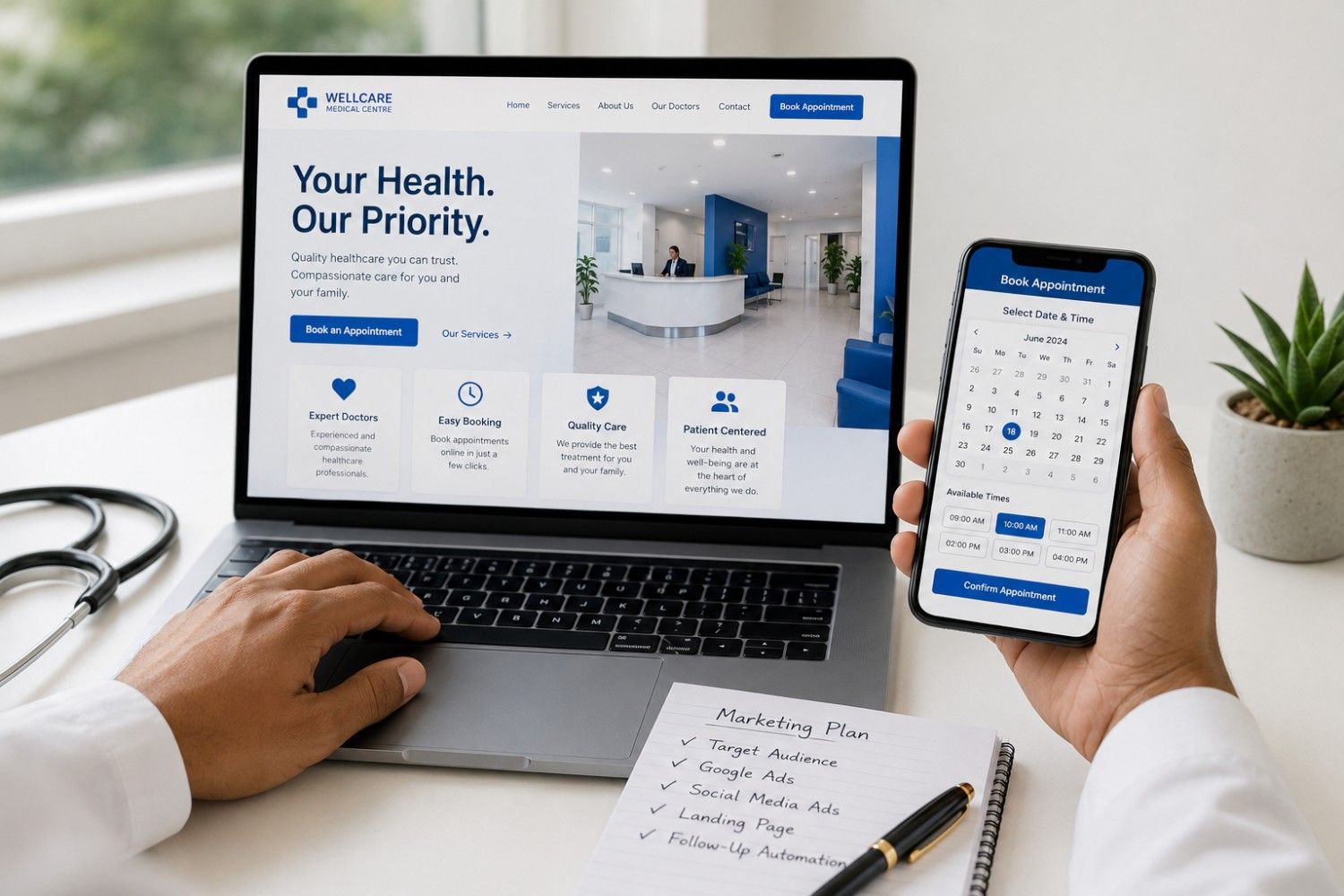
Once someone clicks through, the landing page or booking form determines whether interest turns into an actual lead. This is one of the most common failure points in the entire funnel: sending paid traffic to a slow, generic homepage instead of a dedicated page addressing the exact concern in the ad. A strong landing page should load quickly, reduce the ask to the essentials, and make clear what happens immediately after someone submits their details.
Book a free strategy call if you want an honest audit of where your current funnel is losing leads.
Step 3: Qualifying and Prioritising
Not every enquiry is equally ready to book. Some people are simply gathering information; others are ready to commit today. A basic qualifying question or two, built into the form or a quick automated message, helps front-desk staff prioritize their time toward the leads most likely to convert quickly, without ignoring the others entirely.
Step 4: Following Up Automatically
This is where most patient acquisition efforts quietly fall apart. Research on buyer behaviour consistently shows that most people do not act on their first interaction with a business; they need a reminder, a nudge, or additional reassurance days later. Without an automated system handling this, busy clinic staff simply don’t have the time to chase every enquiry manually, and leads go cold.
A strong follow-up sequence typically includes an immediate acknowledgment, a helpful follow-up within 24 hours, and a final gentle reminder a few days after that. Daniel Iloh Limited builds exactly this kind of automation into the Funnel-IT and Email-IT systems it delivers for healthcare clients, ensuring no enquiry is left unanswered simply because no one had time to respond.
Step 5: Converting to a Booked Appointment
The final step is removing any remaining friction between “interested” and “booked.” This usually means offering multiple simple ways to confirm: an online calendar, a WhatsApp message, or a quick phone call, rather than forcing every patient through a single rigid process that may not suit them.
Best Channels for Medical Lead Generation
Google Search Ads
Search ads capture people actively looking for a solution right now, which makes them one of the highest-converting channels available to any healthcare business. Someone searching “urgent dental appointment near me” has clear, immediate intent, and a well-structured campaign can capture that lead before a competitor does.
Facebook and Instagram Ads
Social platforms are better suited to reaching people who have a need but haven’t started actively searching yet. Meta’s own guidance recommends testing several ad variations against a defined audience to find which message resonates before scaling budget – a step many healthcare businesses skip in their rush to launch.
Speak to our team about building a Facebook and Instagram campaign specifically for your service lines.
Local SEO and Google Business Profile
Not every lead needs to come from paid spend. A fully optimised Google Business Profile, complete with services, hours, and reviews, generates a steady stream of free enquiries from people searching locally, and it compounds over time rather than stopping the moment ad spend pauses.
Referral and Partnership Channels
Partnerships with related businesses (e.g., a physiotherapist referring to a nutritionist, or a GP practice referring to a specialist clinic) can be a reliable, low-cost source of leads. Formalising these relationships with a simple referral process, rather than leaving them informal and inconsistent, often unlocks meaningful volume that was previously left on the table.
Structured referral partnerships work best when both sides understand exactly what a good referral looks like and have a simple, low-friction way to pass it along – such as a shared form, a direct WhatsApp line, or a dedicated email address – rather than a vague verbal agreement that quietly fades after the first few months. Clinics that revisit and reinforce these partnerships quarterly tend to sustain far more consistent volume from them than those that set them up once and never follow up.
Measuring Medical Lead Generation Effectively
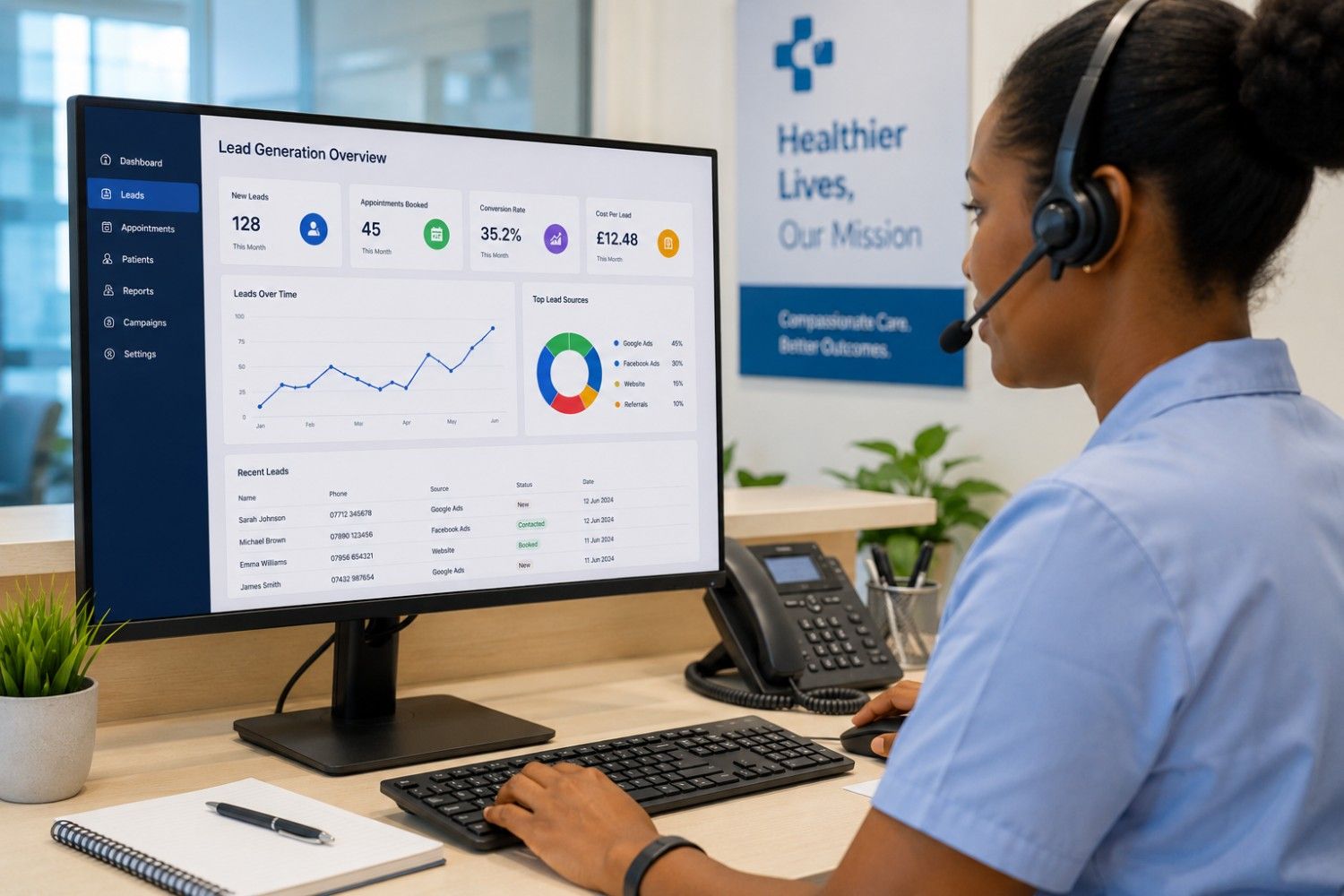
Tracking is what separates a genuinely effective system from one that simply feels busy. At minimum, clinics should track:
- Cost per lead: how much you spend to generate each enquiry
- Lead-to-booking conversion rate: what percentage of enquiries actually become appointments
- Cost per booked patient: the number that ultimately determines whether a campaign is profitable
- Lead source: which channel each enquiry originally came from, so budget can be shifted toward what’s working
Without this visibility, it is impossible to know whether a campaign is genuinely working or simply generating activity that looks encouraging on the surface but produces few actual patients.
Common Mistakes That Sabotage Medical Lead Generation
- Sending all traffic to a generic homepage instead of a dedicated, concern-specific landing page
- No follow-up system, relying entirely on manual staff effort that inevitably falls behind
- Overly long or intrusive forms that discourage anxious or busy prospective patients from completing them
- Ignoring the mobile experience, despite the majority of healthcare searches happening on phones
- Treating every lead the same, rather than prioritising based on readiness to book
Avoiding these mistakes often improves conversion rates more dramatically than simply increasing ad spend.
Qualifying Leads Without Feeling Cold or Clinical
One tension healthcare businesses face is that qualifying a lead – figuring out how serious or ready they are – can easily come across as bureaucratic or uncaring if done poorly. A long intake form full of unnecessary questions will lose anxious prospective patients before they ever submit it. The better approach asks only what is genuinely needed to route the enquiry correctly: a name, contact details, the general concern, and perhaps a preferred appointment window.
Anything beyond that can wait until the actual consultation. Clinics that trim their forms down to the essentials consistently see higher completion rates, simply because the barrier to enquire feels lower and less intimidating.
The Cost of Doing Nothing
It is worth being honest about what happens when a clinic has no structured process at all. Enquiries arrive through a mix of phone calls, Facebook messages, website forms, and walk-ins, with no consistent way of tracking who responded, who didn’t, and who eventually booked. Some leads get answered same-day; others sit unanswered for a week because the person responsible was busy with patients. A percentage – often larger than owners expect – simply never gets followed up at all.
The financial cost of this is easy to underestimate because it is invisible: nobody sees the patients who never booked, only the ones who did. Building even a basic tracking and follow-up system tends to reveal, often uncomfortably, just how many opportunities were previously being lost every single month.
Aligning Front Desk Staff With the System
Technology alone doesn’t solve lead generation problems if the people answering the phone or replying to messages aren’t aligned with the process. Front desk and reception staff are often the actual point of conversion, and a warm, well-briefed team member closing a booking makes a bigger difference than any ad campaign. Clear scripts for common questions, a simple process for logging every enquiry, and clarity on who follows up when, all matter as much as the marketing that brought the lead in the first place.
Clinics investing in automation should still take time to train staff on how to use the new leads flowing in, since even the best-built funnel underperforms if the humans at the other end aren’t equipped to close the loop.
A Simple Example: Two Enquiries, Two Outcomes
Picture two prospective patients who both fill in an enquiry form for the same clinic on the same day, both asking about the same treatment. In the first scenario, the form lands in a shared inbox nobody checks until the following afternoon, the reply is generic, and by the time anyone follows up again the person has already booked elsewhere. In the second scenario, an automated message confirms receipt within seconds, a team member calls within the hour with a warm, specific response referencing exactly what they asked about, and a friendly reminder goes out two days later if they haven’t yet booked.
Same enquiry, same clinic, same treatment – but two very different outcomes. The only difference is the system sitting behind the enquiry form. This is the entire premise behind treating patient acquisition as an engineered process rather than something left to chance or whoever happens to be free at the front desk that day.
Frequently Asked Questions
How quickly should a healthcare business respond to a new enquiry?
Ideally within minutes, and certainly within the hour. Response speed is one of the strongest predictors of whether an enquiry converts, since prospective patients often contact more than one provider and tend to book with whoever responds first and most helpfully.
Is paid advertising necessary, or can organic channels alone generate enough leads?
Organic channels such as local SEO and reviews can sustain a steady baseline over time, but they build slowly. Most growing healthcare businesses use paid advertising to generate consistent volume in the short term while organic channels mature in the background.
What is a reasonable conversion rate from enquiry to booked appointment?
This varies by service and price point, but many well-run healthcare funnels convert somewhere between 20% and 40% of qualified enquiries into booked appointments. If your rate sits meaningfully below this, the issue is usually somewhere in the follow-up process rather than the initial advertising.
Building a Lead Generation System That Doesn’t Depend on You
The healthcare businesses that scale most successfully treat lead generation as a system rather than a series of one-off campaigns. That means dedicated landing pages for each service, automated follow-up that runs whether or not staff are free to respond, and clear tracking that shows exactly where the budget should go next. When these pieces are in place, medical lead generation stops depending on any single person remembering to follow up, and starts running reliably in the background.
Daniel Iloh Limited builds this kind of system specifically for healthcare clients, combining funnel design, paid advertising, and automation so that clinic owners can spend their time on patient care rather than chasing leads manually. For a broader look at how a structured funnel approach works across industries, HubSpot’s guide to marketing funnels outlines the same core stages – attract, capture, nurture, convert – that apply directly to a medical lead generation system.
Book your free strategy session with Daniel Iloh Limited to see exactly where your current lead generation process is losing patients, and what a fully automated system could look like for your practice.
In conclusion, medical lead generation is not simply about attracting more enquiries; it is about building a reliable system that captures, qualifies, and follows up with every inquiry until it either books or is genuinely not a fit. From the first ad someone sees to the automated message that brings them back a few days later, each stage of the funnel either adds friction or removes it. Clinics that treat this as a deliberate system, rather than a loose collection of efforts, consistently convert more of their enquiries into booked, paying patients.
If you would rather have this built and managed for you, explore Daniel Iloh Limited’s Funnel-IT service or get in touch to discuss a lead generation system tailored to your healthcare business.