

Want to know how to get cleaning contracts with offices, schools, and commercial clients? This guide gives African-owned cleaning businesses in the UK a step-by-step strategy to win bigger, longer contracts.

CONTRACT IS WHERE THE REAL MONEY LIVES!
Ask any successful cleaning business owner what changed their business, and the answer is almost always the same: contracts.
Not one-off jobs, not sporadic referrals, not £80 domestic cleans booked week to week. Regular, recurring cleaning contracts with commercial clients; offices, schools, gyms, restaurants, landlords, housing associations that provide predictable income, month after month, without the constant hustle of finding new clients.
If you have ever wondered how to get cleaning contracts that actually grow your business rather than just fill your schedule temporarily, this guide is for you.
Daniel Iloh Limited has helped numerous African entrepreneurs and cleaning business owners across the UK build serious, contract-based revenue streams. In this guide, we break down exactly how to get cleaning contracts from identifying the right targets to pitching professionally, following up effectively, and closing deals that last.
Want to build a contract pipeline for your cleaning business? Book a free strategy session with Daniel Iloh Limited and let us show you how.
WHY CLEANING CONTRACTS ARE THE FOUNDATION OF A SCALABLE BUSINESS
Before diving into tactics, let us be clear about why understanding how to get cleaning contracts matters so much for long-term business growth.
– Predictable revenue: A commercial cleaning contract worth £800 per month that runs for 12 months is worth £9,600; before you even think about upselling or renewing. Stack several of those and your cash flow becomes stable and foreseeable.
– Efficient operations: Recurring contracts mean you know where your team is going, how long jobs take, and what supplies you need. That operational clarity makes your business easier to manage and more profitable to run.
– Business valuation: If you ever want to sell your cleaning business, or raise investment, a book of signed contracts is one of the most valuable assets you can present.
– Reputation compounding: One successful contract with a well-known local business or institution opens doors to others. Commercial clients talk to each other. A trusted reputation in one sector spreads.
PRACTICAL STEPS NEEDED IN LANDING CONTRACTS
Step 1: Identify Your Target Contract Clients
The first step in learning how to get cleaning contracts is deciding which types of clients you want to target. Not all contracts are equal and not all clients are the right fit for your current team size, equipment, and expertise.
Commercial cleaning contract opportunities in the uk;
– Offices and co-working spaces: Regular daily or weekly cleans, often on long-term retainer agreements. Predictable hours, predictable income.
– Schools and educational institutions: Term-time and holiday cleaning contracts. Local authority and MAT (Multi-Academy Trust) procurement routes available.
– Gyms, leisure centres, and sports clubs: High-footfall environments needing frequent cleaning. Once contracted, these tend to renew reliably.
– Restaurants, cafés, and hospitality venues: Daily deep cleans, kitchen cleans, and end-of-night cleaning services. Some of the highest-paying per-hour contracts in the industry.
– Medical and dental practices: Clinical cleaning with specific compliance requirements. Higher pay rates to reflect specialist standards.
– Retail stores and shopping centres: Varied hours including early morning and late evening. Multi-site clients can become significant revenue relationships.
– Landlords and property management companies: Regular void cleans, end of tenancy cleans, and sometimes ongoing maintenance cleans for managed properties. Excellent for building volume quickly.
– Housing associations and local councils: Tendering for public sector contracts can be complex but the contracts are long, stable, and substantial. Daniel Iloh Limited can help you navigate the tender process for these opportunities.
Start with the segment closest to your current capabilities and expand from there. Trying to win every type of contract simultaneously leads to spreading yourself too thin.
Step 2: Build the Credentials Commercial Clients Expect
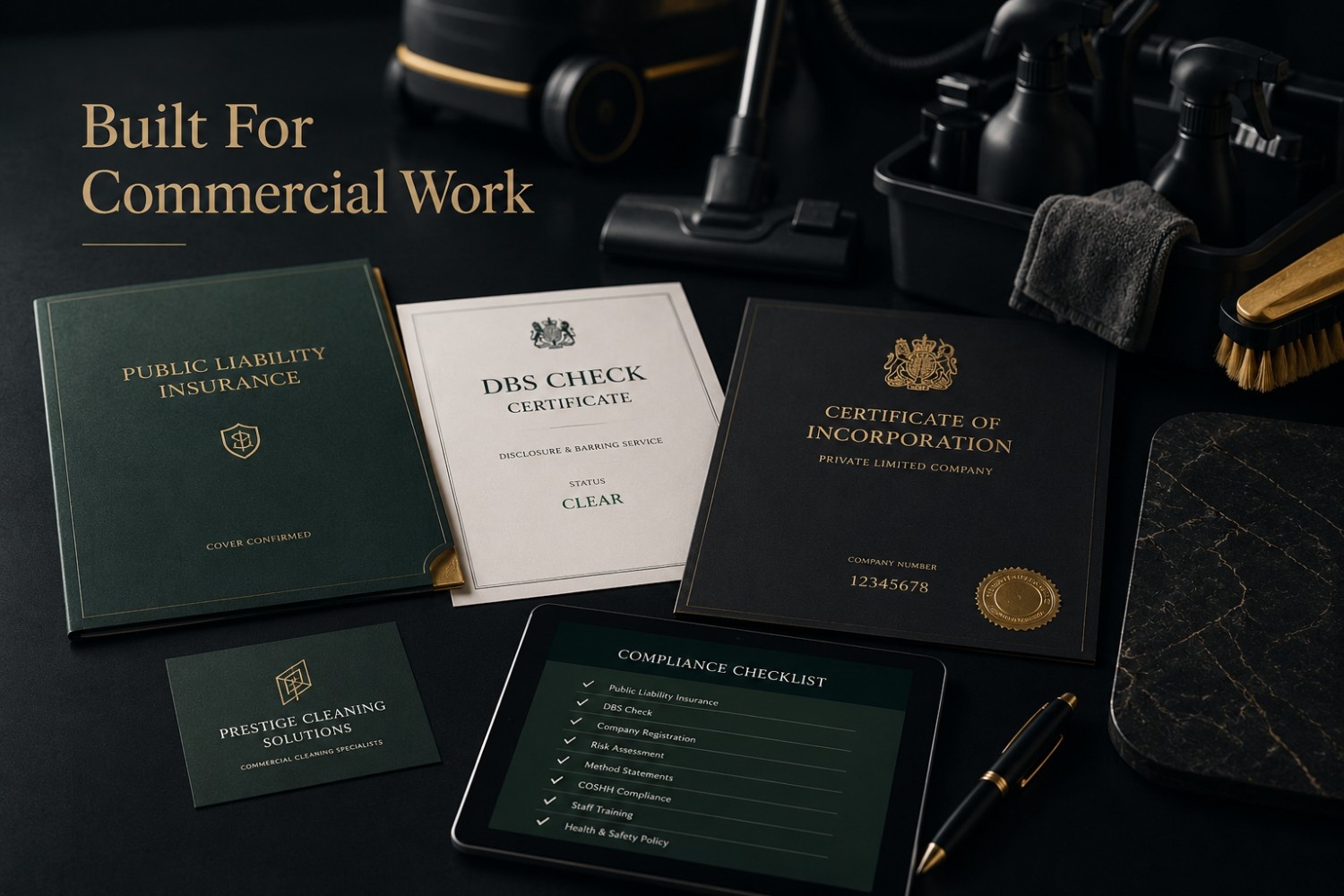
Knowing how to get cleaning contracts is partly about strategy but it is also about being genuinely ready for commercial work. Before approaching a commercial client, ensure you have the following in place.
Essential credentials for commercial cleaning contracts;
– Public liability insurance: Non-negotiable. Most commercial clients will not even consider you without proof of public liability insurance, typically £1 million or £2 million minimum cover. Have your certificate ready to share at any moment.
– Employer’s liability insurance: Required by law if you have employees, and expected by professional clients regardless.
– DBS checks: For any contract involving schools, healthcare settings, or vulnerable populations, your team will need Disclosure and Barring Service (DBS) checks. Having these in place before you pitch shows you are serious and prepared.
– Company registration: Operating as a limited company rather than a sole trader lends credibility when approaching larger organisations. It also offers legal protection and can be a requirement for some public sector tenders.
– Written systems and procedures: Can you demonstrate that your cleaning processes are consistent, documented, and quality-controlled? A simple operations manual or quality checklist signals professionalism to procurement teams.
– COSHH compliance: Demonstrate that your team is trained in the Control of Substances Hazardous to Health (COSHH) regulations and that you handle chemicals safely.
– Getting these credentials in place is foundational to learning how to get cleaning contracts with serious commercial clients. Do not pitch without them.
Step 3: Create a Professional Cleaning Proposal
A professional written proposal is often what separates cleaning businesses that win commercial contracts from those that lose them. Even if your service is superior, a poorly presented or absent proposal kills deals.
Things a winning cleaning proposal must include;
– Executive summary: A brief, confident overview of who you are, what you offer, and why this client should choose you. Keep it to one paragraph; direct and compelling.
– Scope of services: Detail exactly what cleaning tasks will be carried out, how frequently, at what times, and by how many team members. The more specific you are, the more confidence you inspire.
– Quality assurance: Explain how you ensure consistent quality; site visits, checklists, client sign-offs, supervision systems, and complaint resolution processes.
– Your team credentials: Insurance certificates, DBS check confirmations, training qualifications, and relevant experience. Include photos of your uniformed team if possible.
– Case studies or references: A brief summary of two or three current or past commercial clients, the challenge you solved, and the outcome. Social proof matters enormously in B2B cleaning contracts.
– Pricing: Present your pricing clearly and professionally, broken down by service if possible. Include any set-up costs, trial period offers, or volume discounts for multi-site contracts.
– Contract terms: Outline your proposed contract length, notice period, review dates, and payment terms.
Need help structuring your sales materials and proposal process? Daniel Iloh Limited’s Funnel-It service helps cleaning businesses build professional, conversion-optimised sales assets that close more contracts.
Step 4: Find Commercial Cleaning Contract Opportunities
You now have your credentials and your proposal template. The next question is: where do you actually find commercial cleaning contracts to bid for?
Where to find cleaning contract opportunities;
– Cold outreach: Identify target businesses in your area; offices, schools, gyms and approach them directly. This can be via a professional cold email, a phone call, or an in-person visit. Cold outreach requires persistence but has a high ceiling.
– Networking: Join your local Chamber of Commerce, Federation of Small Businesses, or industry associations. Attend networking events regularly. Many commercial cleaning contracts are won through relationships, not tenders. Being known and trusted in local business circles is invaluable.
– Government tender portals: For public sector contracts, use platforms like Contracts Finder, the UK government’s official procurement portal to search for cleaning contract opportunities with councils, NHS trusts, schools, and government buildings.
– Property and facilities management companies: These companies manage multiple commercial sites and outsource cleaning to contractors. Build relationships with local facilities managers and you can access multiple contracts through one relationship.
– Estate agents and letting agencies: A consistent flow of end-of-tenancy and void property cleans that can form a regular contract with the right agency.
– Business directories and referrals: List your business on sector-specific directories and ask existing commercial clients for referrals to their business contacts. B2B referrals convert at extremely high rates.
– LinkedIn: For commercial cleaning marketing, LinkedIn is significantly more valuable than Facebook. Connect with facilities managers, office managers, property developers, and operations directors in your target geography. Share content that demonstrates your expertise and reliability.
Daniel Iloh Limited runs targeted prospecting systems that identify and reach commercial cleaning contract opportunities on your behalf. Our Funnel-It Service is specifically designed to build you a pipeline of qualified leads so you are not starting from zero every month.
Step 5: Follow Up Like a Professional

One of the most overlooked aspects of how to get cleaning contracts is the follow-up. Research consistently shows that the majority of business deals are won after five or more contact points yet most cleaning businesses give up after one or two.
A professional follow-up system for commercial contracts;
Day 1: Send your proposal or initial outreach
Day 4: Follow-up email referencing your proposal and offering to answer any questions
Day 10: A brief, friendly phone call to check whether they received your proposal and gauge interest
Day 18: A value-add email; share a relevant tip, an article, or a case study relevant to their business
Day 25: Final follow-up with a gentle deadline;“I am finalising my schedule for next month and wanted to check in before confirming availability”
This sequence keeps you visible without being pushy. It demonstrates professionalism, persistence, and genuine interest, all qualities that commercial clients want to see in a cleaning partner they will be inviting into their premises regularly.
Never lose track of a follow-up again. Daniel Iloh Limited’s Email-It service can set up an automated follow-up sequence for your commercial leads so every prospect is nurtured consistently and professionally.
Step 6: Price Your Cleaning Contracts for Profit
Many cleaning businesses win contracts and still struggle financially because they have underpriced their services. Knowing how to get cleaning contracts is only half the equation, you also need to price them correctly.
How to price a commercial cleaning contract;
– Calculate your true costs first: Labour (including employer’s NI and holiday pay), cleaning materials and equipment, insurance, transport, management time, and overheads. These must all be factored in before you set your price.
– Research local market rates: Know what comparable contracts in your area are priced at. Do not simply undercut competitors; compete on value, reliability, and professionalism.
– Price for growth: Many new businesses undercharge when starting out and then struggle to raise prices with existing clients. Price competitively from the start, not desperately.
– Include a management margin: If you are building a business rather than buying yourself a job, your price must include enough margin to cover the cost of managing the contract, replacing staff if needed, and generating profit.
– Consider trial period pricing: Offering a one-month trial at a slight discount reduces the risk for the client and gets you in the door. Once they experience your service, transitioning to full contract rate is much easier.
Step 7: Win Renewals and Build Long-Term Relationships

Winning a contract is the beginning, not the end. The real value of a cleaning contract is in the renewal and then the next renewal, and the referral it generates, and the case study it creates.
Strategies for winning contract renewals:
– Conduct quarterly review meetings with the client to discuss feedback and service quality
– Proactively suggest improvements or additional services before the contract renewal period
– Introduce loyalty pricing or added value for long-standing clients
– Ensure handover is smooth if team members change, consistency is critical
– Send a renewal proposal 60 days before the contract end date, not 10
Daniel Iloh Limited helps cleaning businesses build long-term client retention systems that reduce churn and increase the lifetime value of every contract. Ask us about our client relationship frameworks when you book your strategy session
COMMON MISTAKES WHEN TRYING TO GET CLEANING CONTRACTS
Even ambitious cleaning businesses make avoidable mistakes in their commercial contract strategy.
– Pitching before you are ready: Approaching large commercial clients without proper insurance, documentation, or credentials wastes your opportunity and damages your reputation. Get your house in order first.
– Competing on price alone: A race to the bottom on price attracts clients who will leave for anyone cheaper. Win on professionalism, reliability, and systems.
– No follow-up process: Sending one proposal email and then waiting is not a strategy. Build a structured follow-up sequence and stick to it.
– Taking on too much too fast: Winning a large contract your team cannot service properly is worse than not winning it at all. Scale your capacity alongside your contracts.
– Ignoring the paperwork: Verbal agreements are risky. Always get contracts signed. Protect yourself legally from day one.
BUILD A COMMERCIAL CONTRACT PIPELINE THAT GROWS YOUR BUSINESS
Learning how to get cleaning contracts is one of the most important investments you can make as a cleaning business owner. Contracts offer stability, scalability, and the foundation for genuine business growth, rather than the exhausting cycle of chasing individual bookings.
The strategy is clear: define your ideal commercial clients, build your credentials, create professional proposals, pursue opportunities through multiple channels, follow up consistently, and price for profitability. Repeat, refine, and grow.
Daniel Iloh Limited has supported African entrepreneurs and cleaning business owners across the UK to do exactly this. From building prospect pipelines to automating follow-up sequences and creating professional sales assets, we provide the systems and support that turn a cleaning business into a cleaning company.
The contracts are out there, you just need the right strategy to win them. Explore our Funnel-It Service to start building your commercial pipeline today, or book a free consultation with Daniel Iloh Limited and let us map out exactly what your business needs to win its next major contract.
The most successful cleaning businesses in the UK are not the ones with the best mops. They are the ones with the best systems. Let Daniel Iloh Limited help you build yours.