

Executive Summary
Every business on earth has a sales funnel—whether it is intentionally designed or completely accidental. If you rely on random customer referrals, word-of-mouth, or passive website visits, your sales funnel is leaky, unpredictable, and vulnerable to competitors. Conversely, businesses that engineer intentional digital sales funnels gain total command over their customer acquisition volume, cost per lead, and revenue predictability.
This master guide demystifies the sales funnel for small and medium-sized business owners across Colorado. You will learn the psychological stages of customer awareness (Eugene Schwartz’s 5 Levels of Awareness), the 4 operational phases of a digital funnel (TOFU, MOFU, BOFU, and Retention), the specific digital assets required at each stage, and how to track critical pipeline metrics to systematically scale your company.
Table of Contents
- → 1. What Is a Sales Funnel? The Blueprint of Buyer Decisions
- → 2. The Psychology of Buyer Awareness: The 5 Levels
- → 3. The 4 Operational Stages of a High-Performing Funnel
- → 4. Stage 1: Top of Funnel (TOFU) – Capturing Attention
- → 5. Stage 2: Middle of Funnel (MOFU) – Nurturing Consideration
- → 6. Stage 3: Bottom of Funnel (BOFU) – Driving the Decision
- → 7. Stage 4: Post-Purchase Ascension – Maximizing Lifetime Value (LTV)
- → 8. Essential Funnel Metrics: Drop-Off Rates, CAC, and LTV
- → 9. Colorado Case Study: Aurora Commercial Cleaning Firm ($195,000 Pipeline)
- → 10. Frequently Asked Questions (FAQs)
1. What Is a Sales Funnel? The Blueprint of Buyer Decisions
At its core, a sales funnel is the step-by-step psychological and operational journey a prospective customer takes from the moment they discover your business exists to the moment they hand you money and advocate for your brand.
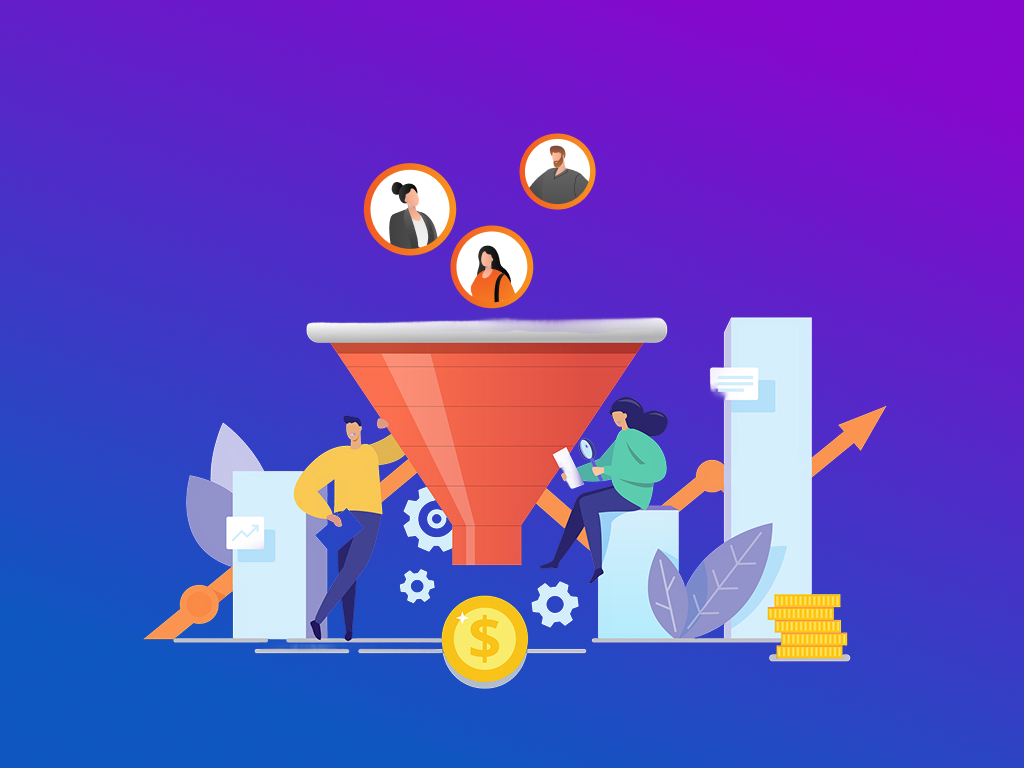
The concept is visualized as a funnel because the number of participants naturally decreases at each stage. At the wide top, hundreds or thousands of prospective clients may see an advertisement or read a blog article. As the journey progresses toward a commercial transaction, only those with genuine need, qualified budgets, and buying urgency move downward into the narrow bottom of the funnel.
Without an engineered sales funnel, businesses treat every visitor identically. They present someone who has never heard of their company with a hard sales pitch, or force an urgent buyer to read three pages of company history before finding a phone number. An intentional funnel delivers the exact right message, proof, and offer at the exact right psychological moment.
2. The Psychology of Buyer Awareness: The 5 Levels
Legendary direct-response pioneer Eugene Schwartz identified that all potential customers exist in one of five distinct mental states. High-performing funnels map their content to these awareness tiers:
- Unaware: The prospect doesn’t even know they have a problem (e.g., an industrial facility manager unaware their roof insulation is leaking heat). Funnels target them with educational stories and industry benchmarks.
- Problem Aware: The prospect realizes they have a problem but doesn’t know solutions exist (e.g., “Our winter heating bill jumped 30%, something is wrong with our building”). Funnels target them with diagnosis guides and symptom checklists.
- Solution Aware: The prospect knows solutions exist but hasn’t selected a provider (e.g., “We need a commercial energy audit or roof coating”). Funnels educate them on different approaches.
- Product Aware: The prospect knows about your company and your solution, but isn’t convinced you are the best choice. Funnels show case studies, reviews, and video proof.
- Most Aware: The prospect is ready to buy and only needs to know the price, terms, and how to get started. Funnels present a clear, frictionless call to action.
3. The 4 Operational Stages of a High-Performing Funnel
In digital marketing, the 5 awareness levels translate into four operational stages: Top of Funnel (TOFU), Middle of Funnel (MOFU), Bottom of Funnel (BOFU), and Post-Purchase Retention.
4. Stage 1: Top of Funnel (TOFU) – Capturing Attention
The top of the funnel is all about building awareness and capturing raw attention. The goal here is not to sell your $10,000 service; it is simply to earn the prospect’s permission to continue the conversation.
Key TOFU digital assets include:
- Targeted Search & Social Ads: Running high-intent campaigns via Prospect Pilot targeting regional Colorado demographics.
- Search-Optimized Pillar Articles: Authoritative educational content managed through our content management system that answers common customer questions on Google.
- High-Value Lead Magnets: Free downloadable resources, checklists, and project cost calculators that provide immediate utility in exchange for an email address or phone number.
5. Stage 2: Middle of Funnel (MOFU) – Nurturing Consideration
Once a prospect exchanges their contact information at the top of the funnel, they enter the middle of the funnel. Here, your objective is to build trust, establish undeniable authority, and position your company as the safest, lowest-risk choice.
Key MOFU assets include:
- Automated Nurture Email Sequences: Delivering a series of 4 to 6 automated emails via email automation that share client case studies, founder stories, and answers to common buying fears.
- Multi-Channel Retargeting Campaigns: Displaying video customer testimonials and proof badges to past site visitors across Facebook and Instagram.
- Interactive Qualification Surveys: Guiding prospects through interactive questions that help them diagnose their specific project requirements.
6. Stage 3: Bottom of Funnel (BOFU) – Driving the Decision
At the bottom of the funnel, prospects are educated, pre-sold on your capability, and evaluating the final transaction. This stage must be engineered with zero friction.
Key BOFU assets include:
- Dedicated Conversion Landing Pages: Sub-2-second, mobile-first pages with a 1:1 attention ratio and sticky CTAs. Review our guide to landing page design elements.
- Frictionless Calendar Scheduling: Direct calendar integration allowing qualified prospects to self-schedule strategy sessions via our consultation booking system.
- Risk-Reversal Guarantees: Explicit warranties, satisfaction pledges, and clear pricing scopes that eliminate final hesitation.
7. Stage 4: Post-Purchase Ascension – Maximizing Lifetime Value (LTV)
The biggest flaw of amateur marketing is assuming the funnel ends when the contract is signed. In elite businesses, the initial purchase is merely the gateway to the most profitable stage of all: customer retention, maintenance retainers, and word-of-mouth advocacy.
Automated post-purchase workflows include:
- Onboarding & Welcome SMS: Reassuring the client immediately after purchase, setting clear project expectations, and reducing buyer’s remorse.
- Automated Review Requests: Triggering Google Business Profile review requests automatically upon project completion.
- Ascension & Referral Campaigns: Introducing seasonal maintenance contracts, equipment checkups, and structured referral incentives.
8. Essential Funnel Metrics: Drop-Off Rates, CAC, and LTV
To optimize a sales funnel, you must measure three vital financial metrics:
| Funnel Metric | What It Measures | Healthy Target Benchmark | How to Optimize |
|---|---|---|---|
| Opt-In / Form Conversion Rate | Percentage of page visitors who submit contact details | 6.0% – 12.0%+ | Simplify form fields, improve headline match, increase page speed. |
| Customer Acquisition Cost (CAC) | Total ad spend + fees divided by new customers acquired | Less than 25% of Customer Lifetime Value | Improve ad Quality Scores, test higher-converting offers. |
| Customer Lifetime Value (LTV) | Total net profit generated by a customer across all transactions | 3x to 5x higher than CAC (3:1 LTV:CAC ratio) | Install automated retention workflows and annual service plans. |
| Speed-to-Lead Time | Minutes between lead submission and first sales contact | Under 60 seconds | Deploy automated SMS auto-responders and live call dispatch. |
9. Colorado Case Study: Aurora Commercial Cleaning Firm ($195,000 Pipeline)
Case Study: Replacing Cold Outbound with an Automated B2B Sales Funnel
The Client: A commercial janitorial and facility maintenance company based in Aurora, Colorado, serving corporate office complexes and medical clinics.
The Problem: The company relied on two sales reps making 80 cold calls a day. Morale was low, close rates were under 3%, and acquiring a new facility contract cost over $2,800 in staff wages and database subscriptions.
The Daniel Iloh Limited Funnel Architecture:
- TOFU: Launched targeted LinkedIn and Google Search campaigns targeting facility directors in Denver and Aurora via Prospect Pilot.
- MOFU: Directed prospects to a custom “Commercial Facility Hygiene & Compliance Checklist” landing page built via sales funnel design.
- BOFU: Configured an interactive 4-question square footage estimator with instant calendar booking via our consultation booking system.
- Automation: Deployed automated SMS reminders and a 5-part video case study sequence via email automation.
Measurable 120-Day Results:
- Commercial Facility Inquiries: Generated 44 qualified commercial walkthrough requests.
- Customer Acquisition Cost: Dropped from $2,800 down to $412 per signed facility agreement.
- New Annualized Revenue: Secured $195,000 in annualized corporate cleaning contracts.
- Sales Team Efficiency: Sales reps completely eliminated cold calling, spending 100% of their time conducting walkthroughs with pre-sold decision-makers.
Ready to Build a Predictable Sales Funnel for Your Business?
Daniel Iloh Limited designs custom, high-converting digital sales funnels, paid acquisition engines, and automated nurturing workflows that scale Colorado companies.
10. Frequently Asked Questions (FAQs)
What is a sales funnel in simple terms?
A sales funnel is the visual representation of the journey a potential customer takes from the very first moment they learn about your business to the moment they make a purchase and become a repeat client.
What are the four primary stages of a sales funnel?
The four classic stages are: 1. Awareness (Top of Funnel – discovering your brand), 2. Consideration / Interest (Middle of Funnel – evaluating solutions and consuming proof), 3. Decision / Action (Bottom of Funnel – booking or purchasing), and 4. Retention / Ascension (Post-Purchase – repeat business and referrals).
Why is it called a ‘funnel’ if not everyone buys?
It is shaped like a funnel because the audience naturally narrows at each stage. You might attract 1,000 people at the wide top (Awareness), capture 100 leads in the middle (Consideration), and close 20 paying clients at the bottom (Decision).
What tools are needed to operate a digital sales funnel for a small business?
A complete digital sales funnel requires three interconnected components: a high-speed landing page builder with interactive forms, a CRM to manage deal stages and lead data, and automated email/SMS workflows to nurture prospects between stages.