

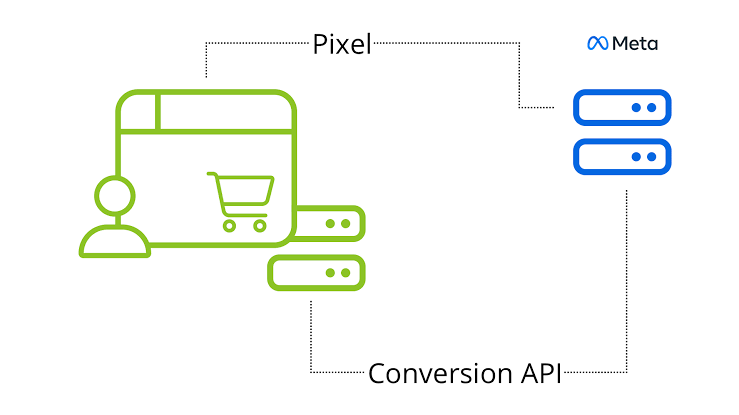
Executive Summary: The Era of Server-Side Advertising Tracking
If your business relies exclusively on the standard browser-based Facebook Pixel, your advertising data is compromised. In today’s privacy-focused web ecosystem, browser-based scripts fail to capture 25% to 40% of real conversion actions:
- The Root Problem: Apple’s iOS App Tracking Transparency (ATT), browser ad blockers (Brave, uBlock, Safari ITP), and cookie lifespan limits routinely block client-side tracking pixels before they can transmit data back to Meta.
- The Solution (Meta Conversions API): The Conversions API (CAPI) creates a direct, server-to-server data pipeline. When a customer converts on your website, your cloud server sends the event securely to Meta, completely bypassing browser filters and ad blockers.
- The Dual Setup: Modern marketing requires running the browser Pixel alongside CAPI with Event Deduplication. This raises your Event Match Quality (EMQ), trains Meta’s algorithm on complete purchase data, and directly reduces your Cost Per Acquisition (CPA).
Table of Contents
- 1. The Tracking Crisis: Why Browser Pixels Are Failing
- 2. What Is the Meta Conversions API (CAPI)?
- 3. Browser Pixel vs. Conversions API: The Dual-Tracking Model
- 4. Event Deduplication: Preventing Double-Counted Conversions
- 5. Technical Comparison: Browser Pixel vs. Server-Side CAPI
- 6. Event Match Quality (EMQ): The Hidden Key to Lower Ad Costs
- 7. How to Implement CAPI: From Gateway to Cloud GTM
- 8. Colorado Case Study: Denver MedSpa Recovers 34% of Lost Conversions
- 9. 5 Best Practices for Flawless Server-Side Tracking
- 10. Frequently Asked Questions (FAQs)
1. The Tracking Crisis: Why Browser Pixels Are Failing
Over the past four years, the technical foundation of digital marketing has undergone an unprecedented transformation. For business owners across the Colorado Front Range—from Denver and Aurora to Boulder, Fort Collins, and Colorado Springs—the consequences have been painful: escalating ad costs, erratic lead reporting, and diminished return on ad spend.
The core cause is not that consumers have stopped buying; it is that the traditional browser-based tracking pixel is fundamentally broken.
Historically, when someone visited your website, the Meta Pixel JavaScript loaded in their web browser, dropped a third-party cookie, and sent data back to Meta. Today, that data path is blocked by three massive privacy barriers:
- Apple iOS App Tracking Transparency (ATT): Since the launch of iOS 14.5, Apple requires iPhone users to opt into data tracking. More than 80% of U.S. mobile users click “Ask App not to Track,” immediately restricting browser cookies and delaying event reporting by up to 72 hours.
- Widespread Desktop and Mobile Ad Blockers: Over 42% of tech-savvy Colorado consumers use ad blockers, privacy-focused browsers like Brave, or Firefox Enhanced Tracking Protection. These tools block traditional JavaScript tracking scripts from even downloading.
- Safari Intelligent Tracking Prevention (ITP) & Chrome Cookie Deprecation: Modern browsers automatically wipe client-side cookie storage after 24 to 72 hours, destroying multi-week attribution windows for high-ticket purchases like home remodeling or commercial services.
If your website solely uses the browser Pixel, Meta’s algorithm is operating with 30% to 40% of its data missing. Learn how this fits into our broader Facebook Pixel setup and conversion tracking framework.
2. What Is the Meta Conversions API (CAPI)?
To overcome browser limitations, Meta engineered the Conversions API (CAPI). Rather than transmitting data from the user’s web browser, CAPI establishes a secure, direct connection between your web server (or CRM) and Meta’s cloud servers.
When a prospect in Littleton submits an estimate request form on your custom landing page, your web server receives that form submission, processes the lead in your database, and simultaneously transmits an encrypted, hashed payload directly to Meta’s API endpoint via server-side HTTPS.
Because this communication happens server-to-server, it is completely immune to:
- Client-side browser ad blockers and script blockers.
- Browser cookie expiration limits.
- Slow mobile network drop-offs where the user closes the page before the browser JavaScript executes.
- Apple iOS client-side restrictions.
By integrating CAPI through our Prospect Pilot customer acquisition engine, Colorado companies guarantee that every qualified inquiry is captured and credited to the winning campaign.
3. Browser Pixel vs. Conversions API: The Dual-Tracking Model
A widespread misconception is that the Conversions API replaces the traditional Meta Pixel. It does not. Meta’s official architectural standard is the Dual-Tracking (Redundant) Model.
Under this architecture, both systems run concurrently:
- The Browser Pixel: Fires inside the visitor’s browser. It captures device-specific browser context, screen resolution, local session data, and immediate click actions.
- The Conversions API: Fires simultaneously from your cloud server. It captures verified backend data, server timestamps, customer data parameters (hashed email, phone, address), and confirmed transaction values.
If an ad blocker stops the browser Pixel, the server-side Conversions API successfully delivers the conversion. If a server misconfiguration occurs, the browser Pixel serves as the safety net. Together, they achieve near-100% conversion capture accuracy.
4. Event Deduplication: Preventing Double-Counted Conversions
If both the browser Pixel and the Conversions API transmit a Purchase or Lead event for the same user transaction, how does Meta avoid counting two conversions in your Ads Manager?
The answer is Event Deduplication. For Meta to successfully deduplicate events, two specific parameters must match exactly between the browser payload and the server payload:
event_name: Must match character-for-character (e.g.,Lead=Lead).event_id: A unique cryptographic string generated by your server or website when the event occurs (e.g.,order_98412_dilor a randomized UUID).
How Meta Processes Deduplication
When Meta receives the browser event with event_id: "lead_78291" and subsequently receives the server event with the identical event_id: "lead_78291" within a 48-hour window, it merges the two events. It logs a single conversion in your reporting dashboard while combining the rich browser telemetry with the verified server-side customer data.
Example Payload with Event ID
fbq(‘track’, ‘Lead’, {
content_name: ‘Solar Assessment Request’,
value: 200.00,
currency: ‘USD’
}, { eventID: ‘solar_lead_884920’ });// 2. Server Event (Back-End JSON Payload sent to CAPI)
{
“data”: [
{
“event_name”: “Lead”,
“event_time”: 1732723200,
“event_id”: “solar_lead_884920”,
“user_data”: {
“em”: [“f660ab912ec121d1b1e928a0bb4bc61b15f5ad44d5efdc4e1c92a25e99b8e44a”],
“ph”: [“e4952089270df82be518df4f54d19d6771d187216a75f850a5f1ee55d996d9a7”],
“client_ip_address”: “73.14.22.180”,
“client_user_agent”: “Mozilla/5.0 (iPhone; CPU iPhone OS 17_4)…”
},
“custom_data”: {
“content_name”: “Solar Assessment Request”,
“currency”: “USD”,
“value”: 200.00
}
}
]
}
5. Technical Comparison: Browser Pixel vs. Server-Side CAPI
Review this side-by-side technical evaluation highlighting the operational differences between both tracking methods:
| Feature / Dimension | Browser-Based Meta Pixel | Server-Side Conversions API (CAPI) |
|---|---|---|
| Data Origin | User’s web browser (Client-side) | Your cloud web server or CRM (Server-side) |
| Ad Blocker Resistance | Poor. Blocked by uBlock, Brave, Safari ITP | 100% Immune. Cannot be blocked by browsers |
| Cookie Expiration Limits | Subject to 24–72 hour browser cookie wipe | Maintains long-term first-party server identifiers |
| iOS 14.5+ Impact | Severe data loss and delayed attribution | Recovers verified server-side conversion actions |
| Event Match Quality (EMQ) | Generally 4.5 – 6.5 out of 10 | Consistently 8.0 – 9.5 out of 10 |
| Offline Conversion Support | No (Only records online page sessions) | Yes (Can send offline signed deals from CRM) |
| Technical Setup Difficulty | Simple (Copy & paste script tag) | Moderate to Advanced (Requires API / Cloud GTM) |
| Impact on Cost Per Acquisition | Higher CPA due to missing conversion data | Direct 15% – 35% reduction in blended CPA |
6. Event Match Quality (EMQ): The Hidden Key to Lower Ad Costs
Inside Meta Events Manager, every data source displays a metric called Event Match Quality (EMQ) scored on a scale from 1 to 10.
EMQ measures how successfully Meta can connect an inbound server event back to a specific Facebook or Instagram user account. If a Denver resident submits your quote form using the email [email protected], but their Facebook account is registered under [email protected], Meta cannot match the lead using email alone.
However, if your CAPI setup passes multiple customer parameters simultaneously, Meta cross-references several data points:
- Hashed Email (
em) - Hashed Phone Number (
ph) – formatted with country code (e.g., +1 for USA) - Hashed First Name (
fn) and Last Name (ln) - Hashed City, State, and Zip Code (
ct,st,zp) - Client IP Address and User Agent
- Facebook Click ID (
fbc) and Facebook Browser ID (fbp)
When your Event Match Quality score climbs above 8.0, Meta’s auction algorithm gains immense clarity on who your ideal buyers are. This allows it to bid more aggressively on high-converting prospects while ignoring low-intent tire-kickers, directly reducing your advertising acquisition costs. Explore our guide on choosing the right Meta campaign objective to maximize these benefits.
7. How to Implement CAPI: From Gateway to Cloud GTM
Depending on your technological infrastructure, there are four primary methods to implement the Meta Conversions API:
Method 1: Conversions API Gateway (Amazon Web Services / Cloudflare)
The Conversions API Gateway is a turnkey cloud solution created by Meta. Hosted on your own AWS or Cloudflare instance, it automatically detects browser Pixel events and translates them into server-side CAPI events with built-in deduplication.
- Best For: Companies with high monthly ad spend ($5,000+) seeking high accuracy with zero custom coding.
- Cost: Free software, but requires roughly $10 to $20/month in cloud hosting infrastructure.
Method 2: Server-Side Google Tag Manager (sGTM)
Server-side GTM routes all website analytics tags through a dedicated cloud server container (hosted on Google Cloud Platform or Stape.io). The client-side tag sends data to your server container, which strips sensitive data and forwards the event to Meta CAPI, Google Analytics, and other advertising platforms.
- Best For: Marketing teams managing multi-channel tracking across Meta, Google Ads, and CRM systems.
Method 3: Native CMS Partner Integrations (Shopify, WordPress)
Both Shopify and WordPress offer native Conversions API integrations:
- Shopify: In the Facebook & Instagram sales channel, select Maximum Privacy / Data Sharing. Shopify automatically enables CAPI with full server-side purchase deduplication.
- WordPress: Plugins like PixelYourSite Pro or the official Meta Pixel for WordPress allow you to paste your CAPI Access Token generated in Events Manager.
Method 4: Custom API Webhooks from Your CRM or Sales Funnel
For custom lead generation funnels engineered through our sales funnel service, we configure direct webhook dispatches to Meta’s Graph API. When a lead books an appointment, our backend server immediately transmits the conversion event with an 8.5+ EMQ score.
8. Colorado Case Study: Denver MedSpa Recovers 34% of Lost Conversions
Case Study: Lowering Patient Acquisition Costs by 45% via CAPI Implementation
The Client: An upscale aesthetic medical clinic and MedSpa located in Cherry Creek, Denver, specializing in body sculpting, laser aesthetics, and facial rejuvenation.
The Prior Problem: The clinic was spending $3,800 per month on Instagram and Facebook ads. Following the widespread adoption of iOS tracking limits among affluent Cherry Creek smartphone users, their reported Cost Per Consultation on Meta Ads Manager had spiked to $118. In reality, the clinic was receiving inquiries, but Meta’s algorithm was blind to over a third of them, causing the campaign to deliver ads erratically.
The Strategic Transformation:
- Infrastructure Upgrade: Deployed a dual-tracking architecture combining the browser Pixel with the Meta Conversions API via server-side GTM.
- Event Deduplication: Configured unique
event_idtags across all consultation booking funnels via our Prospect Pilot landing page system. - Advanced Customer Parameter Hashing: Passed hashed first name, phone number, email, and Denver zip codes, elevating Event Match Quality from 4.8 to 8.9 out of 10.
- Automated Nurturing Integration: Connected verified booking events to our automated email and SMS follow-up workflows.
The 60-Day Results:
- Total Monthly Ad Spend: $3,800/month (Unchanged budget).
- Recovered Conversion Events: Identified an additional 34% of previously unrecorded consultation bookings.
- Cost Per Booked Patient: Decreased from $118.75 to $64.40 (a 45% reduction in acquisition cost).
- Monthly Inbound Consultations: Grew from 32 to 59 qualified patient consultations per month.
- Gross Package Revenue: Closed $92,500 in aesthetic treatment packages in 60 days.
9. 5 Best Practices for Flawless Server-Side Tracking
Maintain data integrity and maximize algorithmic bidding efficiency by following these five server-side tracking rules:
- Always Implement Redundant Tracking: Never shut off your browser Pixel when deploying CAPI. Run both in tandem to capture browser-level session data alongside server-level reliability.
- Verify Event ID Synchronization: Ensure your website developer uses the exact same randomized
event_idstring for both the client-side JavaScript trigger and the server-side API POST request. - Hash All Customer Data on the Server Before Transmission: Meta requires SHA-256 hashing for emails, phone numbers, and names. If you use official partner plugins, this hashing occurs automatically. If coding a custom webhook, ensure your server hashes strings to lowercase SHA-256 hex format.
- Feed Offline Closed Deals Back to Meta: Don’t stop at website leads. When a lead turns into a signed $25,000 contract 30 days later in your CRM, upload an offline
Purchaseevent via CAPI. This teaches Meta which specific ad clicks generated real money. - Audit Your Diagnostics Tab Weekly: In Meta Events Manager, check the Diagnostics tab regularly. It alerts you immediately if event match quality drops, if deduplication fails, or if server payloads fail to deliver.
Future-Proof Your Advertising
Stop Losing 30% of Your Advertising Conversions
Daniel Iloh Limited configures enterprise-grade Meta Conversions API (CAPI) infrastructure, high-converting sales funnels, and automated lead nurturing systems that maximize Colorado business revenue.
Schedule Your Free Server-Side Tracking Consultation
10. Frequently Asked Questions (FAQs)
What is the Meta Conversions API (CAPI)?
The Meta Conversions API (CAPI) is a server-side data integration tool that allows businesses to send marketing data (such as website events, offline sales, and lead form submissions) directly from their web server to Meta’s servers, rather than relying on browser-based tracking scripts.
Does the Conversions API replace the Meta Pixel?
No. The Conversions API does not replace the Meta Pixel; it complements it. Meta recommends running both simultaneously in a redundant setup with event deduplication. This ensures that if a browser script is blocked by an ad blocker or privacy setting, the server event still registers.
What is Event Deduplication in Meta CAPI?
When both the browser Pixel and the Conversions API send the same event (such as a purchase), Meta uses an ‘event_id’ and ‘event_name’ parameter to match them. Meta counts the event only once while combining the rich data points from both sources, preventing duplicate reporting.
What is Event Match Quality (EMQ)?
Event Match Quality is a score from 1 to 10 in Meta Events Manager that measures how effectively your server data (hashed customer email, phone, IP address, external ID) matches back to actual Meta user accounts. Higher EMQ scores result in better ad optimization and lower Cost Per Lead.
Why is CAPI critical for Colorado service businesses?
Because over 40% of mobile users on the Front Range use Apple devices with strict privacy settings or desktop browsers with ad blockers. Without CAPI, your campaigns appear to have higher acquisition costs than reality, causing Meta’s algorithm to deliver ads inefficiently.