

AIRPORT TRANSFER MARKETING STRATEGIES THAT INCREASE RESERVATIONS. Airport transfer businesses operate in a high-demand space, but demand alone does not guarantee bookings. Every day, travelers search for reliable transport to and from airports, yet only a small number of businesses consistently capture that demand.
The difference is visibility, trust, and conversion structure. Customers are often making decisions quickly, based on urgency, timing, and confidence in the service provider. In most cases, the business that appears first and communicates reliability clearly gets the booking.
If your airport transfer business is not showing up at the right moment or not converting interest into bookings, you are losing customers to competitors who understand digital marketing systems.
At Daniel Iloh Limited, we help service-based businesses build structured acquisition systems that turn search intent into confirmed bookings, using a combination of SEO, paid ads, and conversion-focused funnels.
This guide breaks down practical airport transfer marketing strategies that increase reservations consistently.
UNDERSTANDING THE AIRPORT TRANSFER CUSTOMER JOURNEY
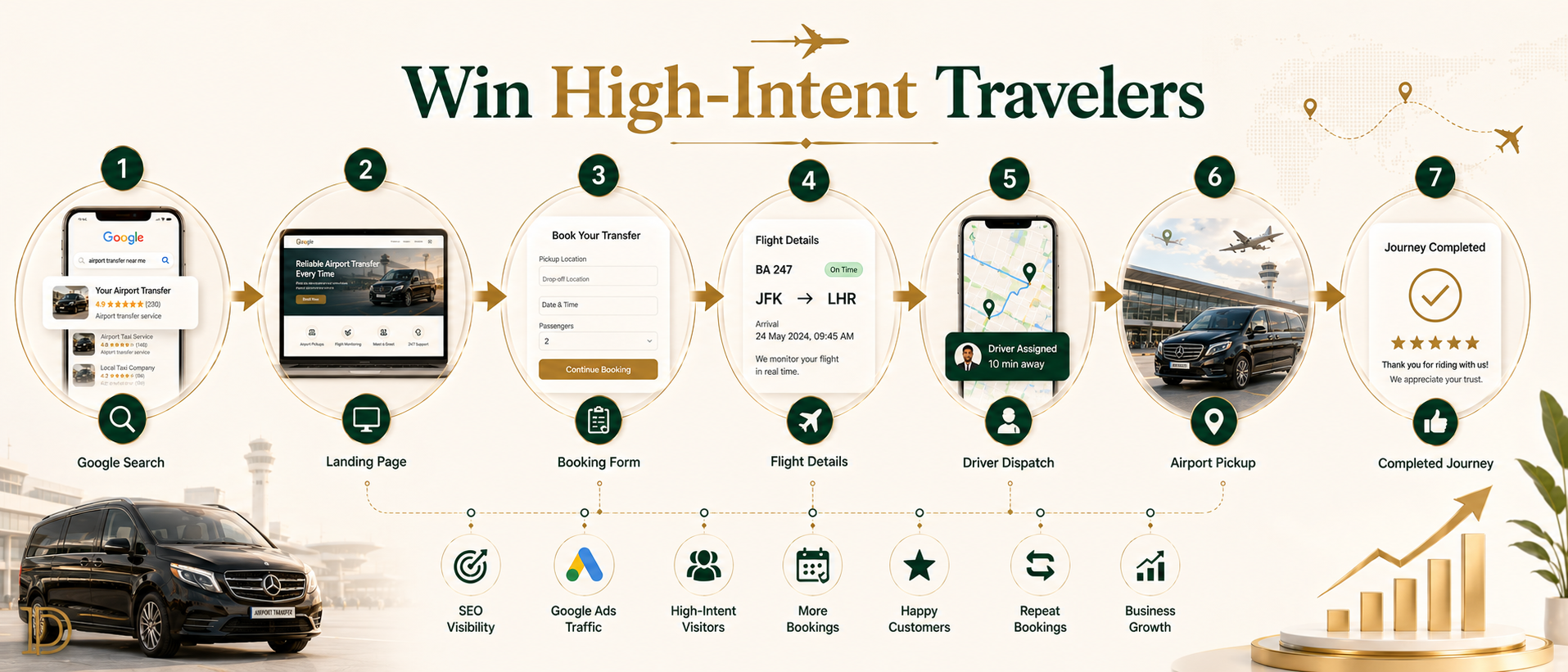
To market airport transfer services effectively, you first need to understand how customers actually make their decisions. Most businesses assume people compare multiple options carefully, but in reality, the process is much faster and more emotional than that.
The airport transfer customer journey usually begins with a trigger. This could be a flight booking confirmation, a return trip arrangement, or even travel anxiety closer to departure time. At this point, the customer is not browsing casually. They are solving a transport problem quickly.
How travelers actually choose airport transfer services;
In most cases, customers shortlist based on what they see first in search results or recommendations. Very few go beyond the first few visible options on Google Maps or paid ads. That means visibility often determines the shortlist before evaluation even begins.
Once a business appears in that shortlist, the decision is shaped by a few key triggers.
Key decision triggers
Price
Customers want clarity, not necessarily the cheapest option. Hidden charges or unclear pricing often push them away faster than higher prices.
Trust and safety
Airport travel involves luggage, timing, and sometimes unfamiliar destinations. Customers look for signs of reliability before booking.
Convenience and timing
Easy booking, fast confirmation, and punctuality matter more than branding. If the process feels slow, they move on immediately.
Online reviews
Reviews act as validation. According to BrightLocal research, most customers trust online reviews as much as personal recommendations.
DIFFERENCE BETWEEN LEISURE VS BUSINESS TRAVELERS
Leisure travelers are more price-sensitive and tend to book slightly earlier. They compare options and look for deals or bundles.
Business travelers behave differently. They prioritize speed, reliability, and professionalism. They are less likely to compare extensively and more likely to choose familiar or highly visible providers.
Understanding this difference is important because it influences messaging, targeting, and ad strategy.
Why last-minute intent is critical in this niche
A significant portion of airport transfer bookings happen close to travel time. This is where urgency is highest and decision-making is fastest.
At this stage, customers are not evaluating deeply. They are choosing the most visible and trustworthy option available at that moment. Businesses that are not visible during this window lose a large share of potential bookings, regardless of service quality.
This is why systems like DIL Funnel-It are often structured around capturing both early-stage awareness and last-minute search intent.
HERE ARE MARKETING STRATEGIES THAT INCREASE RESERVATIONS CONSISTENTLY.
-
CAPTURE HIGH-INTENT AIRPORT SEARCH TRAFFIC
Airport transfer customers usually search with urgency and clear intent. Terms like “airport taxi near me,” “Heathrow transfer service,” or “reliable airport pickup” indicate immediate booking needs.
Google prioritises local intent results through Maps and search listings, especially for mobile users. According to Google Business insights, local search behaviour is strongly action-driven, meaning users are closer to booking than browsing.
This makes visibility critical at the exact moment demand appears.
Optimising your Google Business Profile and building airport-specific landing pages ensures your business appears consistently in these high-intent searches. This is often the first and most reliable source of bookings for airport transfer companies that take local SEO seriously.
-
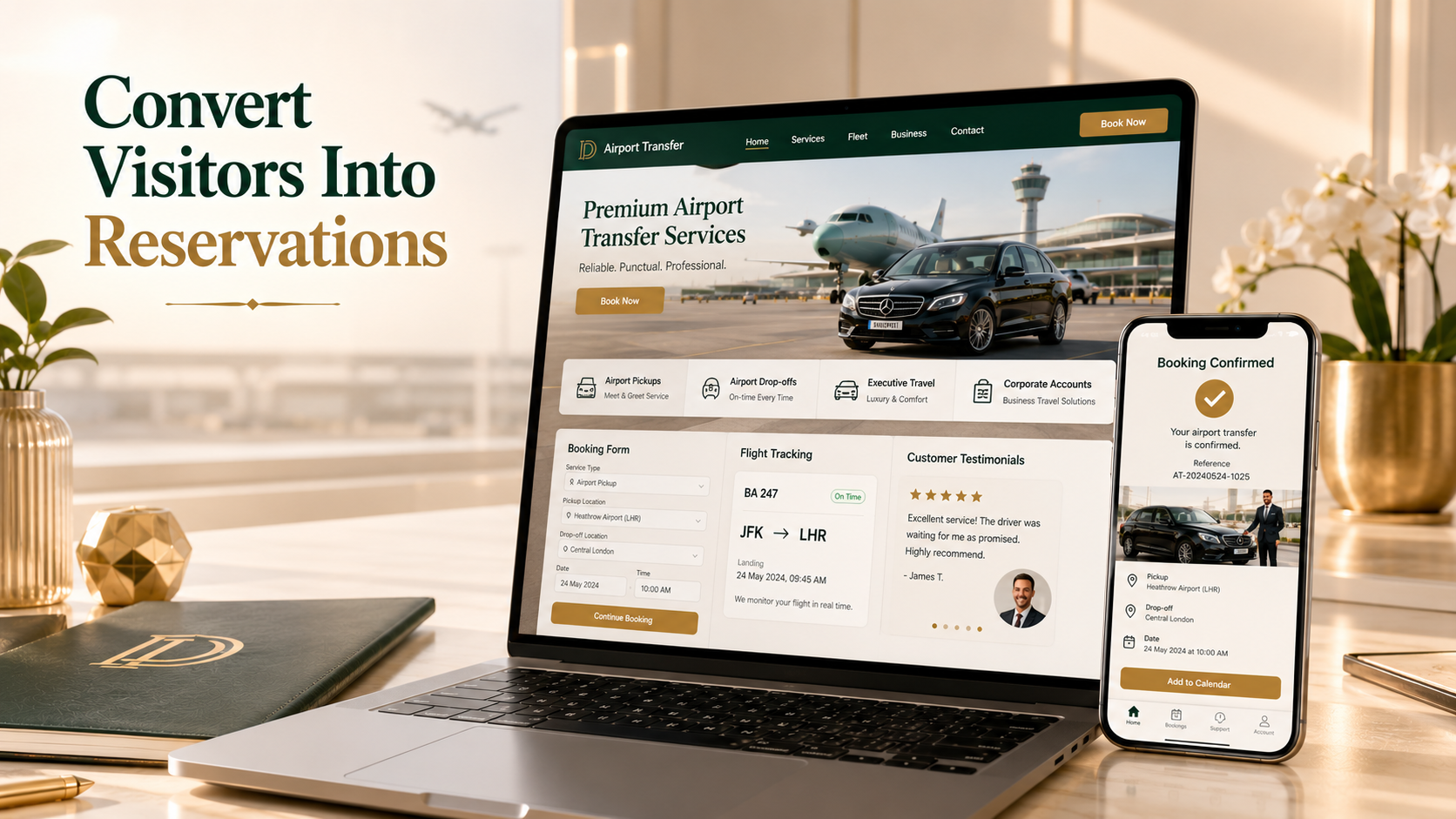
BUILD LANDING PAGES THAT MATCH TRAVEL INTENT
Most airport transfer businesses lose bookings because all traffic is sent to a general homepage that does not match customer intent.
A better approach is to build dedicated landing pages for specific travel needs, such as:
- Airport pickups
- Airport drop-offs
- Specific airports like Heathrow, Gatwick, or local equivalents
Each page should clearly communicate service coverage, booking process, and customer expectations. This reduces confusion and improves conversion rates because users immediately feel they are in the right place.
From a search perspective, this also improves relevance signals, which supports ranking performance.
Systems like DIL Sales Funnel service help structure these pages into a guided booking flow, ensuring visitors move from interest to booking without friction.
-
USE GOOGLE ADS FOR IMMEDIATE AIRPORT BOOKINGS
SEO builds long-term visibility, but Google Ads captures urgent demand instantly.
Airport searches are time-sensitive. A customer arriving in a few hours will choose the most visible and reliable option available, not the cheapest or most researched one.
Focus campaigns on:
- Airport taxi booking keywords
- Call extensions for instant bookings
- Location-based targeting near airports
Google Ads documentation confirms that search ads perform best when aligned with high-intent queries, especially in local service categories.
However, performance depends heavily on structure. Sending traffic to a generic homepage reduces conversion rates significantly. Dedicated landing pages are essential.
At Daniel Iloh Limited, we often see businesses waste ad budgets not because ads are wrong, but because the funnel behind them is not built for conversion.
-
STRENGTHEN TRUST THROUGH REVIEWS AND SOCIAL PROOF
Airport transfer customers are more cautious than regular taxi users because the service involves timing, travel stress, and unfamiliar locations.
Before booking, they are asking silent trust questions:
- Is this service reliable?
- Will they arrive on time?
- Are other customers satisfied?
According to BrightLocal research, over 80% of consumers trust online reviews as much as personal recommendations.
This makes reviews a direct conversion factor, not just reputation management.
Consistent review generation, visible testimonials, and real vehicle images significantly increase booking confidence and reduce hesitation.
-
USE SOCIAL MEDIA TO INFLUENCE EARLY TRAVEL DECISIONS
Not all airport bookings happen at the moment of search. Many decisions are made days before travel begins.
Facebook and Instagram help shape those early decisions by exposing potential customers to your brand before they search.
Effective content includes:
- Airport travel preparation tips
- Customer experiences
- Vehicle quality showcases
- Limited-time travel offers
This builds familiarity, so when the customer eventually searches, your business already feels familiar and trustworthy.
Businesses that combine awareness campaigns with structured systems like DIL Funnel-It often see higher conversion rates from social traffic because the audience has already been warmed up before search intent appears.
-
BUILD PARTNERSHIPS WITH HOTELS AND TRAVEL BUSINESSES
Hotels, travel agencies, and corporate organisations generate consistent airport transfer demand, often daily.
These partnerships reduce reliance on ads and search alone, creating a more stable booking pipeline.
A single hotel partnership can produce recurring airport pickups, especially for international guests who require transport immediately upon arrival.
This is one of the most underutilised growth channels in airport transfer marketing, despite its stability and predictability.
-
USE FOLLOW-UP SYSTEMS TO INCREASE REPEAT AIRPORT BOOKINGS
Many airport transfers are repeat journeys, but most businesses fail to follow up with previous customers.
Customers who travel once will likely travel again, yet they are rarely reminded or re-engaged.
Email and SMS reminders for return trips, seasonal travel, and business schedules significantly improve repeat booking rates.
Research from Harvard Business Review confirms that retaining customers is more cost-effective than acquiring new ones. Automation tools like DIL Email Automation Service help maintain these relationships consistently without manual effort.
COMMON MISTAKES THAT KILL AIRPORT TRANSFER BOOKINGS
Many airport transfer businesses do not lose customers because of poor service. They lose customers because of small operational and marketing gaps that interrupt the booking process.
These issues often appear minor, but they directly affect conversion rates.
-
No clear CTA
One of the most common problems is the absence of a clear call to action.
Customers may find the business online, but if it is not immediately obvious how to book, call, or get a quote, they leave.
Every landing page, ad, and profile should guide users toward a single action. Without that, interest does not convert into bookings.
-
Slow response time
Speed matters significantly in airport transfer bookings.
Many customers contact multiple providers at the same time. The first business to respond clearly and professionally often wins the booking.
Delayed responses, especially on WhatsApp or inquiry forms, lead to lost opportunities even when pricing and service are competitive.
-
Weak Google presence
If a business is not visible on Google Maps or local search results, it is effectively excluded from most customer decisions.
Most airport transfer searches start on Google. A weak profile, incomplete information, or poor optimisation reduces visibility and trust at the same time.
Google’s own local search behaviour data confirms that users rely heavily on map results when choosing nearby services.
-
No reviews or social proof
A lack of reviews creates uncertainty.
Customers are less likely to book a service they cannot validate through past experiences.
Even a small number of recent, consistent reviews can significantly improve conversion rates. Social proof reduces hesitation and reinforces reliability.
-
Overcomplicated booking process
If booking requires too many steps, explanations, or back-and-forth communication, customers often abandon the process.
In this industry, simplicity wins.
A clear booking flow, minimal form fields, and instant confirmation significantly increase completed reservations.
Systems like DIL Sales Funnel service are designed specifically to reduce this friction and guide users directly from interest to booking without unnecessary steps.
In conclusion, airport transfer marketing is not about doing more promotion. It is about being present at the exact moment customers are searching, building trust within seconds, and making the booking process as simple as possible.
The businesses that consistently win in this space are not the ones doing random marketing activities. They are the ones that combine search visibility, structured landing pages, paid advertising, strategic partnerships, and customer follow-up systems into one connected growth structure.
When these elements work together, airport transfer demand becomes predictable instead of inconsistent. Bookings stop depending on chance and start flowing through a system that works in the background.
This is the approach we implement at Daniel Iloh Limited. We help transport and service-based businesses build structured customer acquisition systems that turn everyday travel demand into consistent, measurable reservations.
If you are looking to increase airport transfer bookings, improve your visibility, and build a system that brings in customers reliably, you can book a free growth strategy session with Daniel Iloh Limited. In this session, we review your current setup and identify the exact gaps limiting your bookings, then map out a clear path to fixing them.
The goal is simple: move your business from inconsistent enquiries to a steady flow of confirmed reservations.