Here is the uncomfortable truth about most logistics businesses: they are extraordinary at delivering and completely forgettable at marketing.
Routes are optimised, drivers are professional, deliveries land on time and yet, the phone does not ring as often as it should. The pipeline is thin, new contract enquiries trickle in rather than flow consistently and somewhere, a competitor with a fraction of your operational quality is winning contracts simply because they are more visible.
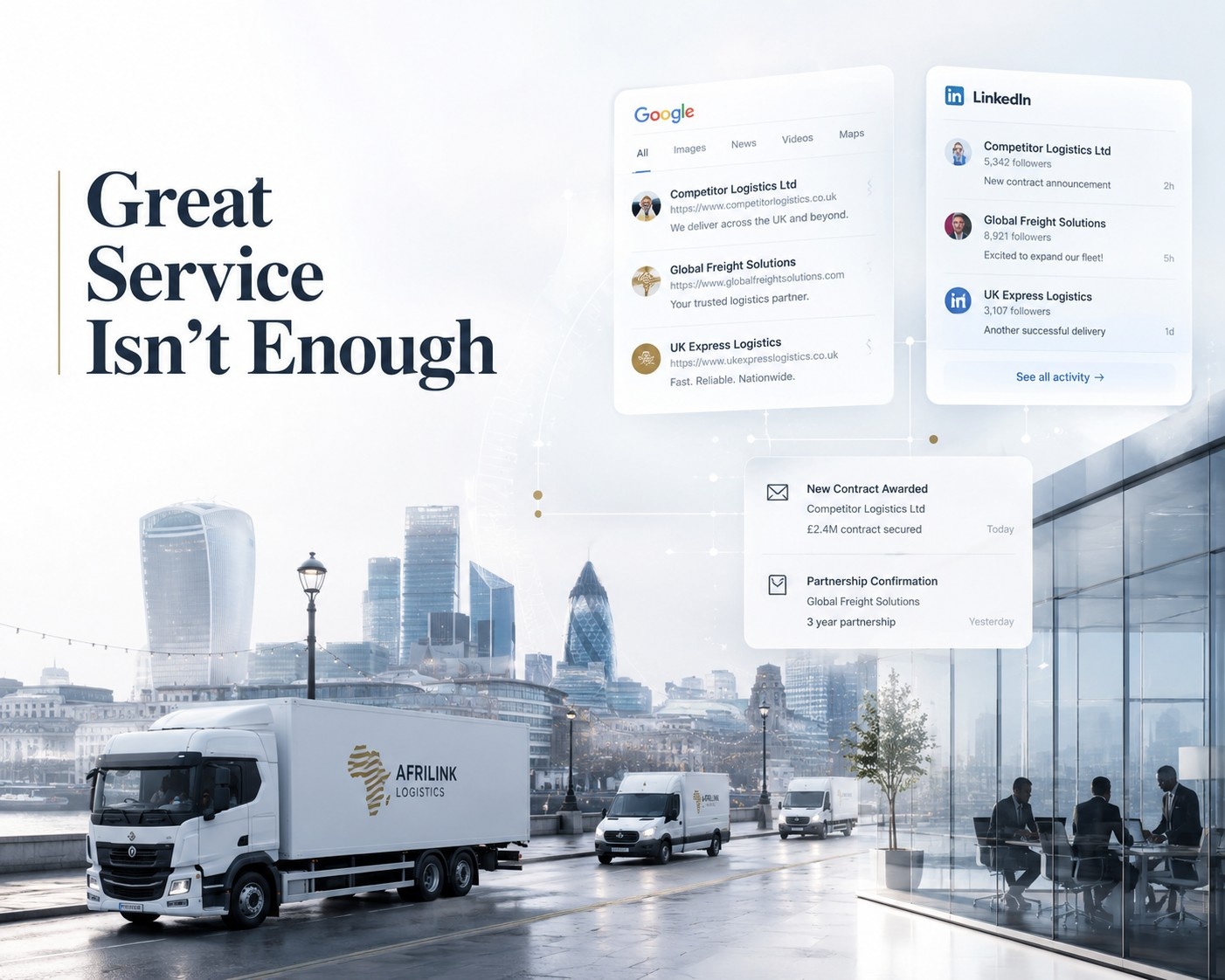
The problem is not your service. It is your logistics marketing strategies or more accurately, the absence of them.
Marketing a logistics or delivery business is not the same as marketing a consumer brand. Your clients are largely businesses. Decisions are made by operations managers, procurement leads, and directors not impulse buyers scrolling Instagram. Reaching them requires a different approach, a different set of channels, and a different kind of messaging.
Daniel Iloh Limited (DIL) has worked with African-owned logistics and delivery businesses across the UK to build marketing systems that generate consistent, high-quality contract leads. In this guide, we break down the logistics marketing strategies that work in 2026 and how to apply them to your business.
Your logistics business deserves clients that match its quality. Book a free growth strategy session with Daniel Iloh Limited and let us build your marketing engine together.
UNDERSTANDING THE LOGISTICS MARKETING LANDSCAPE
Before choosing your marketing channels and tactics, it helps to understand the landscape you are operating in.
Logistics is a B2B-dominant industry. While some courier services target individual consumers, the most valuable, highest-margin logistics contracts come from businesses; retailers, manufacturers, distributors, healthcare providers, professional services firms, and more.
Trust and reliability are the primary purchase drivers. A business choosing a logistics partner is not looking for the cheapest option. They are looking for the provider they can trust with their goods, their reputation, and their client relationships. Your logistics marketing strategies must communicate reliability above everything else.
Long sales cycles are normal. A commercial logistics contract does not close in one phone call. Decision-makers evaluate options, request quotes, check references, and often need multiple touchpoints before committing. Your marketing must sustain visibility across that entire journey.
Competition is intensifying. The UK logistics sector is crowded, and large operators have significant marketing budgets. African-owned and independent logistics businesses must out-target, out-position, and out-communicate rather than out-spend.
With this context in place, here are the logistics marketing strategies that deliver results.
-
BUILD A PROFESSIONAL, B2B-OPTIMISED WEBSITE
Your website is the centrepiece of all your logistics marketing strategies. It is where every lead eventually lands whether they found you through Google, LinkedIn, a referral, or an advert.
What a High-Converting Logistics Website Needs;
– Service clarity: Clearly list every service you offer, same-day delivery, next-day, scheduled runs, specialist freight, last-mile, B2B distribution, warehousing with dedicated pages for each. Vague service descriptions lose potential clients immediately.
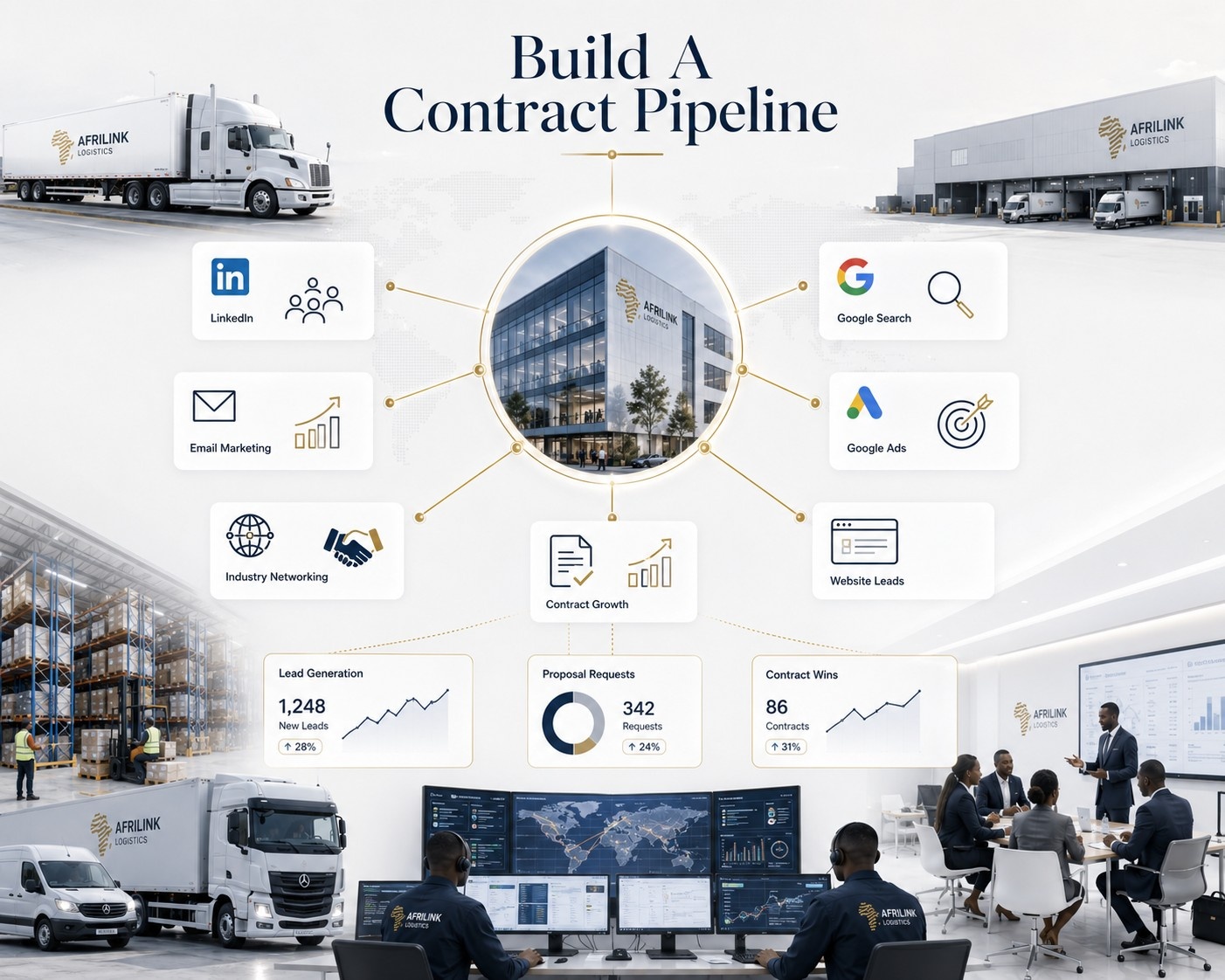
– Location signals: Your service areas should appear prominently throughout your website. A business in Manchester looking for a logistics partner will quickly leave a website that does not confirm local coverage.
– Social proof: Client testimonials, case studies, contract volumes, and delivery statistics build immediate credibility. Quote specific results wherever possible “delivered 12,000 consignments in 2024 with a 99.2% on-time rate” is far more persuasive than general claims.
– Professional imagery: Branded vehicles, uniformed drivers, and clean depot photography communicate professionalism instantly. Invest in quality photography early, it pays back in conversions.
– Simple, prominent calls to action: Every page should push visitors toward a next step requesting a quote, booking a consultation, or downloading a service brochure.
– Loading speed and mobile optimisation: A logistics client researching suppliers from their phone or tablet expects a fast, seamless experience. Technical performance directly impacts your credibility.
-
LINKEDIN: THE SINGLE MOST POWERFUL PLATFORM FOR LOGISTICS MARKETING
For B2B logistics marketing strategies, LinkedIn is in a category of its own. It is where logistics decision-makers are professionally active, where procurement managers discover suppliers, and where industry authority is built in plain sight.
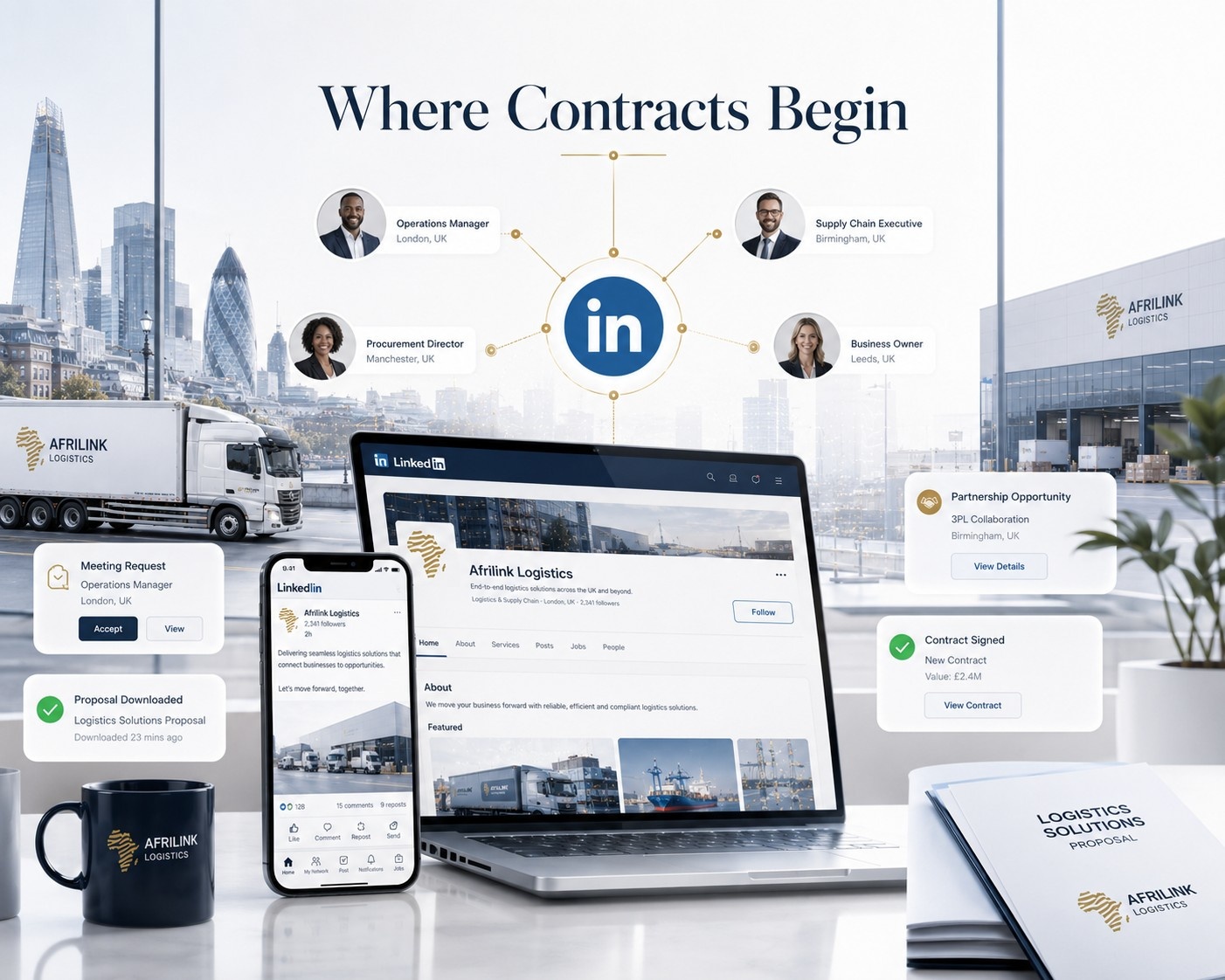
LinkedIn Strategies for Logistics Businesses;
– Optimise your company page: A professional, complete LinkedIn company page with a clear description of your services, your service areas, and your client focus is the starting point for all LinkedIn activity.
– Build your personal brand as the business owner: People buy from people. As an African entrepreneur in the UK logistics sector, your personal LinkedIn profile sharing insights, client wins, industry commentary, and behind-the-scenes content builds the trust that turns connections into contracts.
– Targeted connection strategy: Identify operations managers, logistics directors, procurement leads, and supply chain managers at companies in your target sectors. Connect with a personalised note, engage with their content, and build relationships before pitching.
– LinkedIn content strategy: Post three to five times per week. Content that performs well for logistics businesses includes: delivery challenges and how you solve them; case studies and client results; industry trends and commentary; team highlights; and behind-the-scenes operational content.
– LinkedIn advertising: For faster results, LinkedIn’s sponsored content and InMail campaigns allow you to target decision-makers at specific companies by job title, industry, and company size. Logistics marketing strategies that combine organic LinkedIn activity with targeted paid campaigns consistently outperform either approach alone.
Ready to turn your LinkedIn presence into a contract pipeline? Daniel Iloh Limited’s Funnel-It service builds the complete B2B digital infrastructure your logistics business needs to convert professional connections into paying clients.
-
SEARCH ENGINE OPTIMISATION FOR LOGISTICS COMPANIES
Organic search is one of the most cost-effective long-term logistics marketing strategies available. When businesses search for logistics partners in your area, you want your company to appear at the top of those results
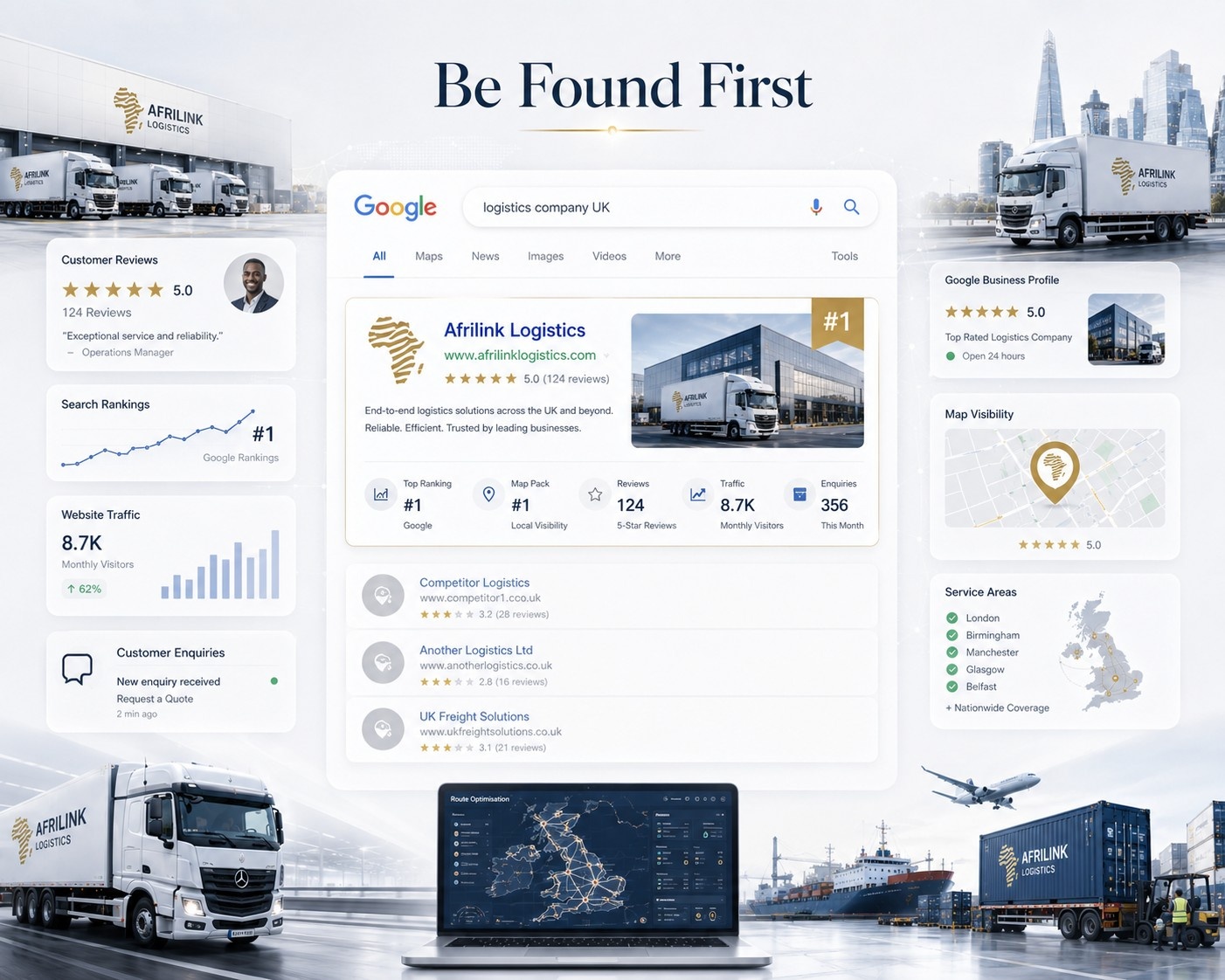
SEO Priorities for Logistics Businesses;
– Target high-intent local keywords:
The most valuable searches for logistics businesses combine a service type with a location:
– “logistics company Birmingham”
– “same-day courier service Manchester”
– “B2B delivery company London”
– “freight distribution West Midlands”
These searches come from businesses actively looking for logistics partners, the highest quality leads in your pipeline.
– Optimise your Google Business Profile:
Set up and fully optimise your [Google Business Profile](https://business.google.com). Include your service areas, operating hours, photos of your fleet, and a detailed service description packed with relevant keywords. Regularly post updates and collect Google reviews from satisfied clients.
– Create service pages for every offering:
Each service you provide should have a dedicated, keyword-optimised page on your website. A generic “services” page does not rank for specific searches. Individual pages for same-day delivery, next-day courier, specialist logistics, and last-mile delivery each target different search queries and different client needs.
– Publish regular industry content:
A logistics blog that addresses the real questions your target clients are asking about supply chain disruptions, delivery cost management, choosing a 3PL partner, and last-mile challenges builds your authority in search results over time. This very guide is an example of how content marketing and SEO work together.
– Build backlinks from relevant directories and industry sites:
Being listed on logistics directories, trade association websites, and relevant business platforms builds the domain authority that helps your website rank higher in competitive search results.
-
GOOGLE ADS: IMMEDIATE VISIBILITY FOR LOGISTICS MARKETING
While SEO builds long-term organic visibility, Google Ads delivers immediate results. For logistics businesses entering new markets or targeting specific contract types, a well-managed Google Ads campaign can generate qualified enquiries within days.
Google Ads Best Practices for Logistics Businesses;
– Target specific, high-intent keywords: Focus your budget on terms like “logistics company near me,” “same-day business delivery [city],” or “distribution company [region]” not broad terms like “logistics” that attract irrelevant clicks.
– Use location targeting precisely: Set your ad radius to match your actual service coverage. Paying for clicks from businesses you cannot realistically serve wastes budget.
– Write an ad copy focused on reliability and trust: “On-time. Every time. Trusted by 200+ UK businesses.” A clear reliability message in your ad copy attracts the right clients and pre-qualifies leads before they even click.
– Track conversions rigorously: Know which keywords and ads are generating actual enquiries and contracts, not just clicks. Google Ads without conversion tracking is expensive guesswork.
Daniel Iloh Limited manages paid advertising campaigns for African-owned logistics businesses, ensuring every pound of your ad budget is generating real, qualified leads. Learn more about our Funnel-It Service and how we identify and reach your ideal logistics clients.
-
EMAIL MARKETING: THE RELATIONSHIP ENGINE IN LOGISTICS MARKETING STRATEGIES
In B2B logistics marketing, the relationship is everything. Email marketing is how you maintain and strengthen those relationships at scale with existing clients, with warm prospects, and with partners.
Email Marketing Sequences for Logistics Businesses;
– New enquiry nurture sequence: When a business first enquires about your services, an automated email sequence that shares your capabilities, client results, and value proposition keeps them engaged while your sales process moves forward.
– Client onboarding sequence: When a new client signs on, a professional onboarding email series sets expectations, introduces your team, and demonstrates the care and attention they can expect from your business.
– Monthly client newsletter: Regular email updates featuring industry insights, service improvements, seasonal capacity information, and relevant news keep your brand top of mind and signal ongoing investment in the relationship.
– Reactivation campaign: For businesses that enquired but did not convert, or past clients who have not used your services recently, a targeted reactivation email sequence with a compelling offer can revive dormant opportunities.
– Referral request emails: Your satisfied clients are one of your most valuable marketing assets. A well-timed referral request email, with an easy process for them to recommend you, generates warm introductions at near-zero cost.
Automate your client communications without losing the personal touch. Daniel Iloh Limited’s Email Automation service sets up your entire email system so every prospect and client receives timely, relevant, professional communication without you managing it manually.
-
CONTENT MARKETING AND THOUGHT LEADERSHIP
Among logistics marketing strategies with long-term compounding returns, content marketing stands alone. Publishing useful, insightful content positions your business as an authority in your sector and authority attracts premium clients.
Content Formats That Work for Logistics Businesses;
– Case studies: Detail how you solved a specific logistics challenge for a client; the problem, your approach, and the measurable results. Case studies are among the most persuasive content formats in B2B marketing because they demonstrate real-world proof.
– Industry guides and whitepapers: “The UK SME Guide to Managing Last-Mile Delivery Costs” or “How to Choose the Right Logistics Partner for Your E-Commerce Business” These in-depth resources attract decision-makers who are actively researching solutions.
– Video content: Short videos showing your fleet, your team, your technology, and your processes build enormous trust with prospective clients. A 60-second video of your GPS-tracked, uniformed team handling a delivery demonstrates professionalism far more effectively than words alone.
– Blog posts: Regular SEO-optimised blog content targeting the questions your ideal clients are searching for drives organic traffic and builds search authority over time.
According to HubSpot’s marketing research , companies that publish regular blog content generate 55% more website visitors and significantly more inbound leads than those that do not. For logistics businesses competing for contract clients, this organic visibility is a genuine competitive advantage.
-
INDUSTRY EVENTS, DIRECTORIES, AND TRADE NETWORKS
Digital logistics marketing strategies are powerful but offline credibility still matters significantly in B2B logistics.
– Industry associations: Joining relevant trade associations (such as the Road Haulage Association, the Chartered Institute of Logistics and Transport, or the Freight Transport Association) provides credibility signals, networking opportunities, and access to tender databases.
– Trade directories and procurement platforms: Listing on platforms used by procurement teams such as Approved Business, CompeteFor, or Nexus; ensures you are visible when businesses are actively sourcing logistics providers.
– Business networking events: Local Chamber of Commerce events, BNI groups, and sector-specific networking bring you face-to-face with decision-makers at exactly the businesses you want to work with. For African entrepreneurs in the UK, diaspora business networks can be particularly valuable for referrals and introductions.
– Trade exhibitions: Attending or exhibiting at logistics and supply chain events puts your business in front of a highly concentrated audience of relevant buyers and partners.
-
MISTAKES THAT UNDERMINE LOGISTICS MARKETING STRATEGIES
Even well-resourced logistics businesses make avoidable marketing errors.
– Targeting consumers instead of businesses: If your real growth opportunity is in commercial contracts but your marketing speaks to individual senders, you are attracting the wrong audience entirely.
– Inconsistent brand presentation: A polished LinkedIn profile combined with a dated, unprofessional website creates a disconnect that erodes trust before a conversation begins.
– No follow-up system: B2B logistics sales cycles are long. A single email or call is never enough. Without a systematic follow-up process, warm leads go cold and opportunities are lost.
– Waiting for referrals only: Referrals are valuable but unpredictable. Logistics marketing strategies must include proactive outbound and inbound channels that generate leads independently.
– Measuring the wrong things: Tracking website visits and LinkedIn followers without measuring actual enquiries, proposals, and conversions is a vanity exercise. Focus on metrics that connect directly to revenue.
In conclusion, your reliability, your team, and your operational excellence are the foundation. But in a competitive market, the logistics businesses that grow are the ones that are most visible, most trusted, and most consistently present in the minds of their ideal clients.
Effective logistics marketing strategies combine a strong digital presence, targeted B2B outreach, relationship-building content, and automated follow-up systems that keep your pipeline full regardless of how busy your operations are.
Daniel Iloh Limited builds these complete marketing systems for African-owned logistics and delivery businesses across the UK from SEO and paid advertising to LinkedIn strategy, email automation, and brand positioning.
Build the marketing engine your logistics business deserves. Book your free consultation with Daniel Iloh Limited and let us show you exactly where your best growth opportunities lie and how to capture them.
The contracts are there. The clients are searching. The only question is whether they find you first.